Laboratory tested
Vegan
Free from artificial additives
Made in Germany
Sustainably packaged
Sort by
Sort by
- 25%
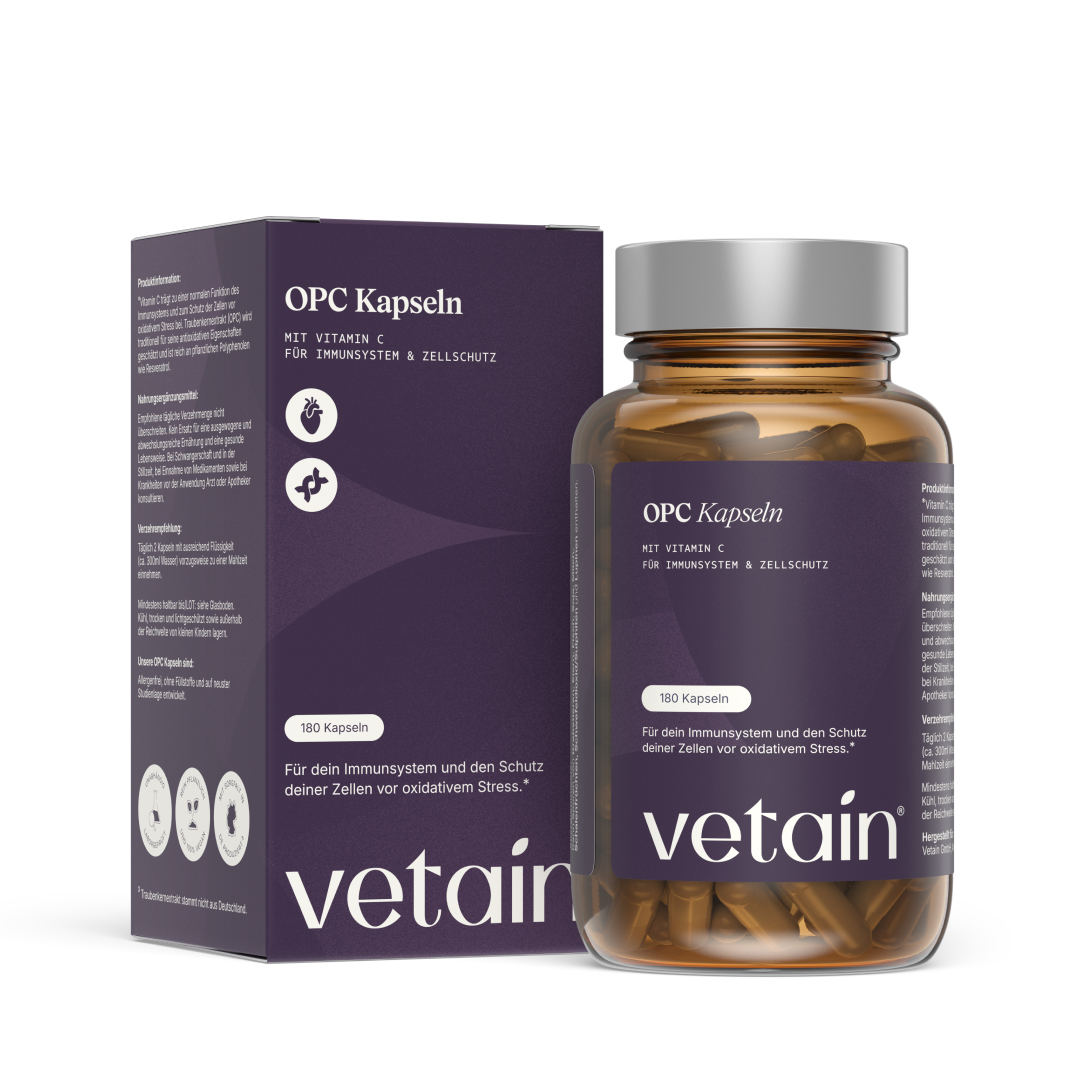
Vetain OPC capsules with vitamin C for immune system and cell protection
MINERALS OPC capsules - Plant-based antioxidants for protection & balance (180 capsules)
€29,99
€22,49
inkl. MwSt.
- 25%
Vetains iodine capsules in high-quality brown glass. Behind it at an angle, the sustainable packaging carton.
MINERALS Iodine complex (180 capsules)
€26,99
€20,24
inkl. MwSt.
- 25%
Vetain Curcumin Capsules
MINERALS Turmeric - liquid curcumin (60 capsules)
€29,99
€22,49
inkl. MwSt.
- 25%
Vetain Biotin Complex Capsules with Zinc and Selenium
MINERALS Biotin Complex - (120 capsules)
€25,99
€19,49
inkl. MwSt.
  • - 25%
    Vetain MSM Capsules 180 Pieces
    MINERALS MSM – Organic Sulfur (180 Capsules)
    €25,99
    €19,49
    inkl. MwSt.
    MINERALS Turmeric Frankincense Complex (90 capsules)
    €24,99
    inkl. MwSt.
    - 25%
    Vetains Shilajit capsules in high-quality brown glass. Behind it at an angle, the sustainable packaging box.
    MINERALS Shilajit - high dose (120 capsules)
    €29,99
    €22,49
    inkl. MwSt.
    NEW - 25%
    Vetain Cranberry + D-Mannose Capsules with Vitamin C and Zinc
    MINERALS Cranberry + D-Mannose (90 Capsules)
    €26,99
    €20,24
    inkl. MwSt.
    sold out ❌ - 25%
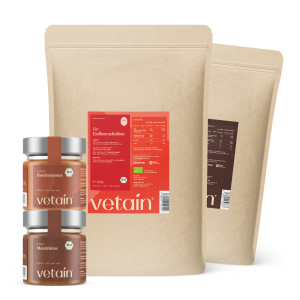
    Vetain autumn bundle: two cans of Protein Iced Coffee Pumpkin Spice and boxes of Creamy Nut-Nougat Protein Bars, isolated on a white background. Promotional sticker “4 for 3”.
    BUNDLES Inner Beauty Bundle
    €131,96
    €98,97
    inkl. MwSt.

    Vitamins and minerals from Vetain 

    Hi, we’re Vetain, a vegan dietary supplements manufacturer. We’ve made it our mission to develop the best dietary supplements. We’ll now explain what matters to us and what good dietary supplements mean to us:

    • Clean vitamins and minerals: We do without unnecessary fillers and additives – our natural dietary supplements contain only the ingredients that genuinely belong in them.
    • Vegan vitamins and minerals: All our products are 100% vegan and cruelty-free. Plant-based dietary supplements are becoming increasingly popular – including among non-vegans.
    • Natural vitamins and minerals: Our vitamin supplements are natural.
    • Tested dietary supplements: Our supplements are regularly tested by independent laboratories.
    • High-dose vitamins and minerals: Our product developers formulate our supplements so that they are dosed appropriately.

    If these values sound great to you too, we’d be delighted if you took a look around our website and perhaps added one or two nutrients to your routine. 
    If you’re unsure which products you need or which dietary supplements you’d like to buy, we have put together a guide to dietary supplements for you here. 


    Different forms of vitamins and minerals

    Vitamins and minerals come in many different forms. The best known are vitamin capsules, vitamin tablets, vitamin powder, and liquid vitamins and minerals (in juice or drop form).
    Which form is best? There’s no clear answer, as all vitamin supplements can have their own advantages and disadvantages. It all depends on your preferences and needs. 
    Let’s take a look at the different forms of vitamins and minerals together.

    • Capsules: Capsules are usually easier to swallow than tablets and can be conveniently taken along when traveling.
      Vetain products: Iron & Vitamin C, Magnesium, OPC, Vitamin C, Omega-3 fatty acids, Vitamin B, Turmeric, Black seed oil
    • Tablets: Tablets are often smaller than capsules, and you only need a little liquid to swallow them.
      Vetain products: Calcium, Zinc
    • Powders: Powders are suitable for anyone who doesn't like swallowing tablets or capsules. They can easily be mixed into a little liquid and then consumed.
      Vetain products: L-Glutamine, vegan collagen type 1, vegan collagen type 2, creatine
    • Drops: Drops are perfect for on the go, as they can be dropped directly into your mouth and no liquid is needed. 
      Vetain products: Vitamin D3 & K2

    When developing our vitamins and minerals, we individually decide which dosage form is best suited for our supplement. That's why you'll find a colorful mix of different tablets, capsules & more.

    Just try out what best suits you and your nutrient routine. A little tip: Thanks to the plant-based capsule shell, our capsules are very easy for most people to swallow - with no sticking.


    Fat-soluble vitamins

    The fat-soluble vitamins include vitamins A, D, E, and K. What makes these 4 vitamins special is that, unlike many other vitamins, they are not water-soluble but, as the name suggests, fat-soluble. This means that they dissolve when they come into contact with fat, allowing the body to absorb them. That is why it is very important to always take fat-soluble vitamins with a fatty meal. Normally, a regular breakfast, lunch, or dinner is sufficient. A snack with healthy fats, such as an apple with peanut butter or fresh nuts, also counts as a fatty meal.
    Especially practical: This type of vitamin can be stored in the body, allowing it to draw on its reserves when needed. However, this also increases the potential risk of an overdose: While an excessive dose of water-soluble vitamins (over a short period of time!) is often simply excreted, an excess of fat-soluble vitamins can accumulate in the body, potentially leading to an overdose in the long term.

    Which fat-soluble vitamins are there?

    • Vitamin A: Vitamin A is found in animal-based foods such as meat, eggs, and dairy products. In plant-based foods such as carrots, spinach, or broccoli, it occurs in the form of provitamin A, which is then converted into the active form in the body. 
    • Vitamin E: Vitamin E is found particularly in nuts, seeds, and vegetable oils. 
    • Vitamin D: As its name suggests, the sunshine vitamin is produced by the body itself when you spend time in the sun. In addition, a few foods, such as fatty fish, contain vitamin D. Many people supplement this vitamin, especially in winter (see: Vitamin D in winter).
    • Vitamin K: Vitamin K is often taken together with vitamin D as a dietary supplement and is otherwise found in green vegetables, meat, or dairy products.


    Water-soluble vitamins

    The next group of vitamins and minerals is the water-soluble vitamins. These include all B vitamins as well as vitamin C. They can easily be dissolved in water and therefore, unlike fat-soluble vitamins, do not necessarily need to be taken with a fatty meal. Instead, a glass of water or another liquid is enough to take the vitamins with. Water-soluble vitamins cannot be stored in the body. Any excess is simply excreted (up to a certain point). For us, this means that we need to make sure to consume them regularly (that is, daily!) through our diet. Our bodies have virtually no reserves of these vitamins to draw on.
    Let's take a look at the vitamins:

    • Vitamin B: Contrary to what you might expect, vitamin B is not just a single vitamin, but rather the collective term for an entire group of B vitamins. This group includes B1 (thiamine), B2 (riboflavin), B3 (niacin), B5 (pantothenic acid), B6 (pyridoxine), B7 (biotin), B9 (folic acid), and B12 (cobalamin). All these vitamins have their own functions in the body. They are often taken in the form of a vitamin B complex. Of particular interest to many: Vitamin B12 is found mainly in animal products, which is why vegans often take vitamin B12 as a supplement.
    • Vitamin C: Vitamin C is perhaps the best-known vitamin and has already been covered on our blog: Daily Vitamin C Requirement. It is found mainly in fruit and vegetables such as peppers, berries, oranges & Co. It is also often taken as a supplement, especially in winter but throughout the year as well.


    Minerals

    Before we really get into the topic, we first need to clarify an important question: What exactly are minerals? Minerals are nutrients that the body cannot produce itself and therefore has to obtain through food. They are essential for life and involved in many bodily functions. Unlike vitamins, minerals are inorganic elements, meaning that they originate, for example, from soil or water and are then absorbed by plants (and animals as well). Vitamins and minerals are both important nutrients and are obtained through our daily diet.

    Let's take a look at a few minerals:

    • Calcium: Calcium is found primarily in dairy products, but is also present in plant-based foods such as leafy green vegetables, broccoli, almonds, and calcium-rich mineral water. Some people, especially women over 50, also like to take calcium supplements.
    • Magnesium: Magnesium is found in nuts, seeds, whole grains, legumes, and green vegetables, and physically active people in particular often take magnesium supplements.
    • Sulfur: Sulfur can be obtained from protein-rich foods such as meat, fish, eggs, legumes, or cabbage. For some time now, however, MSM has also been receiving increasing attention as a sulfur compound sold as a supplement in capsule form.
    • Iron: Iron is a particularly relevant topic for people who menstruate, and many turn to dietary supplements. Iron is also found in various animal-based and plant-based foods.
    • Zinc: Zinc can be obtained through a balanced diet from meat, cheese, eggs, oats, nuts, and legumes, and zinc supplements can also contribute to zinc intake.
    • Iodine: In Germany, the general recommendation is to use iodized salt.


    Buy vitamins | Order simply and conveniently

    If you are still looking for high-quality dietary supplements, you have come to the right place. At Vetain, you will find a wide selection of vitamins and minerals to support your nutrient intake.
    Before you start shopping in our dietary supplement store, we would like to briefly draw your attention to our other supplements, which do not directly belong to vitamins and minerals.

    • L-Glutamine: L-Glutamine is an amino acid that is particularly popular as a supplement among physically active people.
    • Omega-3 fatty acids: Our vegan algae-based omega-3 alternative provides omega-3 fatty acids, which are traditionally found in fish.
    • Vegan collagen: Vegan collagen alternatives are interesting for people who would like to supplement with collagen but also don’t want to use animal products.
    • Creatine: Many physically active people take creatine supplements as a regular part of their gym routine.
    • Turmeric: Turmeric is a root that contains the plant compound curcumin. Many people know turmeric from the popular ginger-turmeric shots.
    • OPC capsules: OPC comes from grape seeds and is now also available as an OPC supplement.
    • Black cumin oil: Black cumin oil is obtained from the seeds of black cumin and has traditionally been used in various cultures - very interesting!

    So, that was all of our supplements. We’ll introduce you to our protein powder & protein bars another time - you’ve already received enough input here. Now it’s finally time to order vitamins!
    Speaking of input, one last thing: In our blog, you’ll find lots of additional information about the individual nutrients. If you like, feel free to hop over after placing your order and browse through our blog. You’re sure to find some topics that interest you - such as how you can get all the vitamins and minerals you need with a balanced diet or which vitamins and minerals you shouldn’t take together.

    DE-ÖKO-007 Siegel

    High-quality organic products made in Germany

    Reviews.io Logo

    Rated independently by customers Reviews.io

    SSL Datensicherheit Siegel

    Secure payment processing through SSL encryption

    Versand durch DHL Go Green Siegel

    Fast & climate-neutral shipping by DHL GoGreen

    Still questions?

    Yes, fat-soluble vitamins in particular (A, D, E, K) can accumulate in the body and cause toxic effects. Overdosing on water-soluble vitamins is less risky, but too much vitamin C or B6 can still have side effects. But don't worry, we've paid close attention to the dosage in our supplements.

    Vegan and vegetarian diets, in particular, are often deficient in vitamin B12, iron, and zinc. Magnesium and calcium can also be insufficient in some diets.

    Absolutely! They not only support overall health but also play a vital role in the body's detoxification process. The liver and kidneys are crucial for neutralizing and breaking down toxins, and certain micronutrients help to optimally support these organs. Therefore, they can aid detoxification. Vitamins and minerals to supply.