





















 Zuletzt aktualisiert am 09.10.2026

B1, B2, B3 … and then suddenly B5? If you have ever wondered which B vitamins there are and where B4 actually went, let’s sort it out together.
Let’s start with a brief explanation: What is vitamin B—or, more precisely, what are B vitamins?
B vitamins are not a single vitamin, but a family of eight vitamins that, despite sharing the same letter, have very different chemical structures. What they have in common: They are water-soluble and often work hand in hand in metabolism. I’ll show you which B vitamins there are and what makes them special.
Your knowledge to go: Which B vitamins are there?
-
There are 8 B vitamins: The B vitamins include B1, B2, B3, B5, B6, B7, B9, and B12.
-
The B vitamins are also called: thiamine (B1), riboflavin (B2), niacin (B3), pantothenic acid (B5), pyridoxine (B6), biotin (B7), folate or folic acid (B9), and cobalamin (B12).
-
Water-soluble: All B vitamins dissolve in water.
-
Team players: The B vitamins work hand in hand. Many B vitamins contribute to normal energy metabolism and the normal functioning of the nervous system; folate also contributes to normal blood formation, while B12 contributes to the normal formation of red blood cells.
-
The individual B vitamins are found in different foods, so variety on your plate is worthwhile.
-
Special focus: Folic acid (B9) is particularly relevant when trying to conceive, while vitamin B12 is especially important on a vegan diet.
Which B vitamins are there? The B-vitamin list
The answer is pleasingly short: There are exactly eight B vitamins. The fact that the numbering nevertheless goes up to 12 has historical reasons, which we will explain further below. Here you can see at a glance which B vitamins there are and why they are important:
| Abbreviation | Full name | Effects & areas of action | Sources (selection) |
|---|---|---|---|
| B1 | Thiamine | Energy metabolism, nervous system | Whole-grain products, oatmeal, pork |
| B2 | Riboflavin | Energy metabolism, skin | Cereal germ flakes, whole-grain products, dairy products |
| B3 | Niacin | Psychological function, reduction of tiredness and fatigue | Fish (salmon), peanuts, meat, mushrooms |
| B5 | Pantothenic acid | Energy metabolism, mental performance | Nuts, whole-grain products, eggs, fish, meat |
| B6 | Pyridoxine | Protein and glycogen metabolism, immune system | Whole grains, fish, hazelnuts and walnuts, red bell peppers, pork |
| B7 | Biotin | Skin and hair | Nuts, oats, soybeans, egg yolk, dairy products, organ meats |
| B9 | Folate / folic acid | Blood formation, cell division | green leafy vegetables (e.g. spinach), legumes, whole-grain products |
| B12 | Cobalamin | Formation of red blood cells, nervous system | Eggs, dairy products, meat, fish, supplements, fortified foods |
The eight B vitamins in detail
You now know which B vitamins there are - time to get to know them better. Here they all are in brief profile.
Vitamin B1 (thiamine)
Thiamine contributes to normal energy metabolism and the normal function of the nervous system. Among other things, your body needs it to obtain energy from carbohydrates. Good plant-based sources include whole-grain products, pork, sunflower seeds, and legumes.
A little nerdy fact: Thiamine is sensitive to heat, air, and water - so gentle cooking and not leaving it in water for too long are worthwhile. By the way, not every B vitamin is so delicate: according to the DGE, niacin is relatively stable when heated.
Vitamin B2 (riboflavin)
Riboflavin contributes to normal energy metabolism and the maintenance of normal skin. Plant-based sources include, for example, cereal germ flakes and whole-grain products, although dairy products are the main sources. This is why the DGE considers vitamin B2 one of the potentially critical nutrients in a vegan diet.
Fun fact: Riboflavin is bright yellow and approved as a food color (E 101).
Vitamin B3 (niacin)
Niacin contributes to normal energy metabolism, normal psychological function, and the reduction of tiredness and fatigue. Good sources include fish such as salmon, peanuts, mushrooms, and meat.
What makes it special: Your body can produce some niacin itself, in small amounts, from the amino acid tryptophan. So a protein-rich diet also contributes to your niacin intake.
Vitamin B5 (pantothenic acid)
Pantothenic acid is found in many foods, especially nuts, whole-grain products, eggs, fish, and meat. It contributes to normal energy metabolism and normal mental performance.
If you're wondering what symptoms a vitamin B5 deficiency might cause: They would be very nonspecific and therefore difficult to recognize. Always have such nonspecific symptoms medically evaluated - and if your doctor then also brings up B vitamins, you'll already have an advantage because you know which B vitamins there are! ;)
Vitamin B6 (Pyridoxine)
Pyridoxine contributes to normal protein and glycogen metabolism and the normal function of the immune system. For anyone who likes eating a protein-rich diet, B6 is an important player. Good sources include, for example, whole grains, fish, hazelnuts and walnuts, pork, and red bell peppers.
Interesting: Vitamin B6 is actually not a single substance at all. The name refers to several compounds with vitamin activity, such as pyridoxine, pyridoxal, and pyridoxamine. So if you're wondering which B vitamins there are, B6 is technically a whole little family.
Vitamin B7 (Biotin)
Biotin contributes to the maintenance of normal skin and hair - which is exactly why you see it on so many beauty labels. Many people also know biotin as the beauty vitamin. It also contributes to normal metabolism of macronutrients and normal psychological function. So B7 is a real all-rounder!
You can find biotin, for example, in nuts, egg yolk, organ meats, oats, dairy products, and soybeans. So porridge with nuts is more than just a cozy breakfast.
Vitamin B9 (Folate/Folic acid)
There are two names for vitamin B9: Folate is the natural form found in foods, while folic acid is the synthetic form found in supplements. Folate contributes to normal blood formation and has a role in cell division. Good sources of folate include green leafy vegetables and legumes. My tip: Steam vegetables rather than boiling them.
Extra tip: If you're wondering which B vitamins become particularly important during a specific stage of life, folic acid is certainly one of them. The DGE recommends that women who want to become pregnant take additional folic acid, namely at least 4 weeks before the start of pregnancy until the end of the first trimester.
Vitamin B12 (Cobalamin)
What is vitamin B12 needed for? It contributes to the normal formation of red blood cells, the normal function of the nervous system, and normal psychological function.
When you look at which B vitamins there are, vitamin B12 is the exception: According to the DGE, it is not possible to obtain an adequate intake solely from plant-based foods. Therefore, supplements are very important for vegans! The tricky part is that because your body has large B12 stores, a vitamin B12 deficiency often develops gradually and unnoticed over many years.
So if you follow a vegan diet, B12 is the most important item on the list. In its position paper on vegan nutrition (2024), the DGE states that B12 should be supplemented regularly and reliably.
%-split_content-%
Where is B4? Why are some B vitamins no longer included?
What actually happened to B4, B8, B10 and B11? In the past, more substances were numbered as B vitamins, including choline (formerly B4), inositol (formerly B8) and para-aminobenzoic acid, or PABA for short (formerly B10). Later, it became clear that the body can produce some of them itself or that they do not meet the criteria for a true vitamin. Today, they are often referred to as vitaminoids, meaning vitamin-like substances. So science simply took a closer look. That is why anyone asking which B vitamins there are today gets eight names with a few gaps in the numbering.
How do B vitamins work: What is vitamin B good for?
You now know which B vitamins there are. But what is vitamin B good for, in a nutshell?
-
Energy: B1, B2, B3, B5, B6, B7 and B12 contribute to normal energy-yielding metabolism.
-
Nerves: B1, B6 and B12 contribute to the normal function of the nervous system.
-
Mind: B6, B9 and B12, among others, contribute to normal psychological function.
-
Blood: Folate contributes to normal blood formation, while B12 contributes to the normal formation of red blood cells.
-
Fatigue: B2, B3, B5, B6, B9 and B12 help reduce tiredness and fatigue.
And which B vitamins are important? Small spoiler answer: all eight. Nevertheless, B12 and folate are often the focus.
Vitamin B deficiency: What symptoms can occur?
You’ve now seen which B vitamins there are - and because they are involved in so many processes, signs of a deficiency can look very different:
-
The BfR cites pale skin, fatigue, tingling or numbness, as well as memory problems, as examples of symptoms of insufficient B12.
-
The DGE lists anemia and neurological disorders as typical symptoms of a B6 deficiency.
-
According to the DGE, too little riboflavin (B2) mainly causes problems affecting the skin and mucous membranes, such as cracks at the corners of the mouth.
But such symptoms can also have completely different causes. Only a medical examination with a blood count can reliably determine whether a deficiency is actually behind them.
Why is everyone talking about vitamin B supplements?
Whether at the gym, on social media, or at brunch - the vitamin B complex is everywhere right now. Are you wondering why? Well, a vitamin complex combines the eight B vitamins in one product, essentially all of vitamin B in one capsule. The idea behind it is simple: cover everything at once instead of keeping track of each B vitamin individually.
A vitamin B complex may be useful if your needs are increased or your diet does not reliably provide every B vitamin - for example, if you follow a vegan diet, during pregnancy, or in the case of a medically diagnosed deficiency.
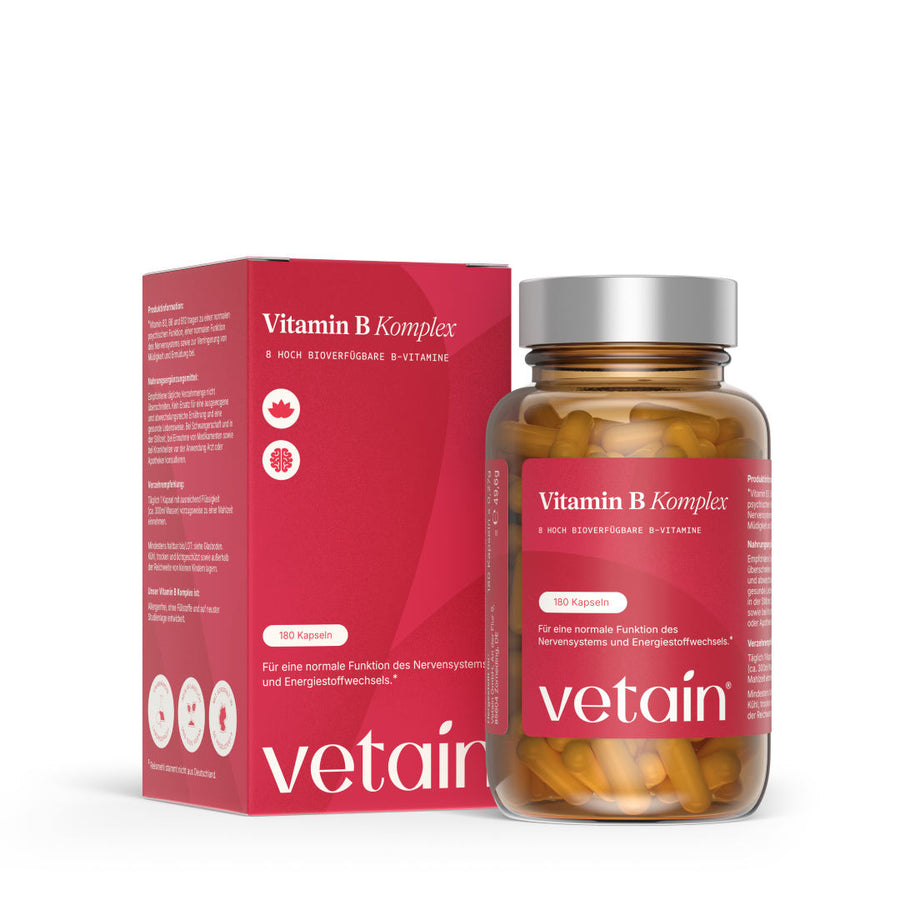
At Vetain, we developed our vegan vitamin B complex specifically for everyday life: It contains each of the eight B vitamins in one vegan capsule and contains no unnecessary additives. It is particularly interesting if you follow a plant-based diet and do not want to think about B12 and its cousins every day.
%-product_content-%
Conclusion: Which B vitamins are there - and what will you take away?
So, which B vitamins are there? There are 8 B vitamins: B1, B2, B3, B5, B6, B7, B9, and B12. They are water-soluble, yet chemically very different, and most of them contribute to normal energy metabolism. The gaps in the numbering come from substances that are no longer considered vitamins today. And if you follow a vegan diet, B12 is certainly a regular supplement for you, while when it comes to B2, it is worth taking a look at whole grains and cereal germ flakes.
Do you have any questions? Then feel free to email me - I look forward to hearing from you! :)
Literature & Sources
-
German Nutrition Society (DGE): Reassessment of the DGE position on vegan diets. Ernährungs Umschau 7/2024.
-
German Nutrition Society (DGE): FAQ on thiamine, riboflavin, niacin, vitamin B6, biotin, folate, and vitamin B12.
-
Federal Institute for Risk Assessment (BfR): Vitamin B12 - people following a plant-based diet should pay particular attention to ensuring an adequate intake. FAQ dated October 18, 2023.
-
Niklewicz A, Hannibal L, Warren M, Ahmadi KR: A systematic review and meta-analysis of functional vitamin B12 status among adult vegans. Nutrition Bulletin, 2024.
-
European Commission: EU Register of nutrition and health claims.