




















 8 Min
8 Min
 Zuletzt aktualisiert am 23.09.2026

You've probably heard that omega-3 fatty acids are important. Maybe you're even already taking a supplement – or considering starting. But How much Omega 3 per day is actually beneficial?? And is it possible to consume too much of it? We'll clarify exactly that in this article.
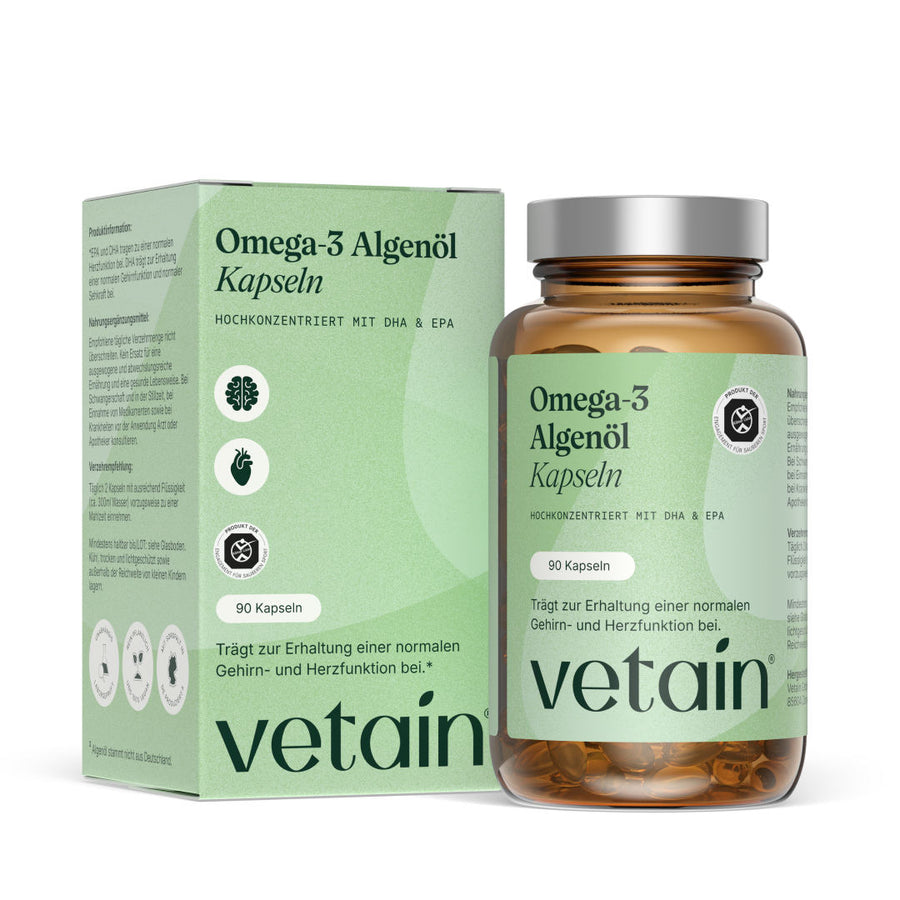
And if you're still looking for one high-quality supplement If you are interested, you can access this site directly and secure your Omega 3 capsules today:
%-split_content-%
Your knowledge to go: How much Omega 3 per day?
-
The best-known omega-3 fatty acids are EPA and DHA: EPA contributes to normal heart function, DHA to normal brain function and vision*.
-
Omega-3 daily requirement for adults: The EFSA recommends 250 mg EPA and DHA per day for the general population. These can be obtained through diet or supplements.
-
Omega-3 during pregnancy: Pregnant women should consume at least 200 mg of DHA daily.
-
Omega-3 in sports & Muscle building: The official recommendation is 250 mg EPA. & DHA per day – studies are investigating higher amounts of 2–5 g daily, but there is no clear recommendation for this.
-
According to EFSA, the following apply: up to 5g Omega-3 per day as harmless For healthy adults. This is particularly important when considering the question "How much Omega 3 per day?".
What is the daily requirement for Omega 3?
The EFSA, the European Food Safety Authority, recommends a daily intake of 250 mg Omega 3 fatty acids in the form of EPA and DHA. This value applies to the general population. Different recommendations exist for specific groups such as pregnant women. More on that later.
This often involves a EPA-DHA ratio of 2:1 The recommended intake is approximately 167 mg of EPA and 83 mg of DHA per day. However, this exact ratio varies from study to study and also depending on the specific goal. Therefore, we will focus here on the total amount of 250 mg.
To take a screenshot:
How much Omega 3 per day? 250 mg!
For comparison: 100 g of salmon contains almost 2-3 g of Omega 3.
Since many people don't eat fish or nuts daily, or drink a flaxseed oil shot, Omega 3 supplements are becoming increasingly popular: Many Omega 3 supplements contain between 250 mg and 500 mg of Omega 3.
Important note: Even though the EFSA recommends an intake of 250 mg per day, the optimal, or "perfect," intake level has not yet been definitively established. Until studies provide conclusive results, we will continue to follow the EFSA's recommendations for the daily requirement of Omega 3.
Omega 3, EPA, DHA – is your head spinning with all the technical terms? Welcome to our deep dive with Vetain, where everything important is explained to you briefly and simply.
Deep Dive: Omega 3, EPA and DHA – what's what?
When considering how much Omega 3 you actually need per day, various terms like EPA or DHA are often mentioned – but what are they all actually?
What is Omega 3?
Omega-3, or more accurately, omega-3 fatty acids, are polyunsaturated fatty acids that are essential for our health. They perform numerous functions in our bodies. Since we can only produce these fatty acids to a limited extent ourselves, we must obtain omega-3 through our diet or supplements. Omega-3 fatty acids include EPA and DHA.
What is EPA?
EPA (eicosapentaenoic acid) is a long-chain omega-3 fatty acid found primarily in oily fish and algae. EPA is particularly associated with processes related to the heart in the body.
What is DHA?
DHA (docosahexaenoic acid) is a long-chain omega-3 fatty acid and, like EPA, is found primarily in fatty fish and algae. DHA is particularly closely linked to the brain and eyes.
In short, the difference is that EPA and DHA are both omega-3 fatty acids and are found in similar foods – but they differ in their role: EPA is primarily associated with normal heart function, while DHA is particularly relevant for the brain and eyesight.
How much Omega 3 per day for specific groups.
How much Omega 3 per day should an athlete consume?
The standard recommendation of 250 mg EPA generally applies here. & DHA per day.
It's often said that athletes supplement with higher doses of Omega 3. Values of 2-5 g daily are sufficient**. The common reasoning behind this is that studies are currently investigating the potential effects of Omega-3 on muscles and regeneration.
How much Omega 3 per day during pregnancy?
Based on the DA-CH reference values, the DGE (German Nutrition Society) recommends that pregnant women consume at least 200 mg of docosahexaenoic acid (DHA) per day. This is because maternal intake of DHA during pregnancy contributes to the normal development of the fetus's brain and eyes. However, please always consult your doctor about this!
How much Omega-3 per day during muscle building?
As explained earlier: The standard recommendation here is 250 mg EPA. & DHA per day. However, some studies show that athletes often supplement with higher doses of Omega 3 when building muscle**.
How much Omega 3 per day should a woman consume?
Women should take 250 mg of EPA. & Take DHA daily.
How much Omega 3 per day in old age?
The general recommendation of 250 mg of omega-3 fatty acids in the form of EPA also applies to older people aged 65 and over. & DHA.
How can one absorb Omega 3?
Omega 3 can be absorbed in various ways:
-
Nutrition: The most well-known way to obtain omega-3 fatty acids is probably through diet. Fatty fish and algae, in particular, contain large amounts of omega-3.
-
Supplements: Vegetarians, vegans, and those who don't regularly eat fish often choose to supplement with Omega 3. You can learn more about this topic in our blog article "Where is Omega 3 found?"
%-product_content-%
Is it possible to overdose on Omega 3?
Yes, as with everything in life, there is such a thing as "too much" Omega-3. However, this is almost exclusively relevant with supplements, and even then the risk of overdose is quite low. The EFSA currently considers an intake (i.e., supplementation) of up to 5 g per day to be safe for the general population.
How much Omega 3 per day is too much?
More than 5 grams of Omega 3 – that's almost 22 Omega 3 capsules from Vetain. That's 11 times more than our recommended intake.
Vetain's assessment: Yes, theoretically it's possible to overdose on Omega-3, but this doesn't usually happen with normal use of sensibly dosed supplements. So there's no need to be afraid of supplementing. However, you should definitely check how much Omega-3 your supplement contains.Vetain contains 450 mg of Omega 3 per daily dose (2 capsules). This is above the basic recommendation, as our product is highly concentrated, but well within the range of a safe amount.
If you accidentally take too much Omega 3, you may experience side effects such as digestive problems (nausea, diarrhea, heartburn, etc.). In such cases, please consult your doctor.
Excursus: Omega 3 and Omega 6
When researching how much Omega-3 you need per day, you often come across information about the recommended ratio between Omega-3 and Omega-6 fatty acids. While this isn't the main topic of this article, I'd like to briefly address it: The commonly recommended Omega-3 to Omega-6 ratio is 5:1.
Conclusion: The optimal Omega 3 dosage
The EFSA currently recommends an intake of 250 mg of omega-3 fatty acids per day in the form of EPA and DHA. Whether this is truly the optimal amount, or whether a slightly lower or higher amount might be even better, is currently being investigated. Therefore, this value should be understood as a general guideline. If you eat fish regularly, i.e., 1-2 times per week, you will likely be fine. If you eat less or no fish (z.B. (because you live a vegetarian or vegan lifestyle) and also nuts & If seeds aren't a regular part of your diet, an Omega 3 supplement might be right for you. If you'd like to meet your needs with a single sip, without having to eat fish, I can recommend supplements like... Vetains Omega 3 Capsules We recommend these – they are 100% fish-free.
Do you have any questions? Then feel free to write me a message. Mail - I look forward to hearing from you! :)
The information shared in this article does not replace individual medical or nutritional advice.
literature & Sources
-
DGE (2018). Uniform recommendations for action during pregnancy updated and expanded.
-
DGE (2016). Press release: Regularly include fish in your diet.
-
EFSA (2012). EFSA assesses the safety of long-chain omega-3 fatty acids.
-
EFSA (2010). EFSA establishes European reference values for nutrient intake.
-
Smollich, M. (2019). Omega-3 fatty acid supplements: Are there evidence-based indications? In: Drug Prescribing in Practice, 46(3-4).
-
Wolfram, G. & Fremann, D. (2001). Reference values with guarantee – guideline values for fat intake. In: Ernährungs-Umschau 07/01.
*With a daily intake of 250 mg EPA and DHA
**We expressly recommend not taking more than the 5g considered safe by the EFSA and refer to the statements approved by the EFSA regarding the effects of Omega 3.