




















 6 Min
6 Min
 Zuletzt aktualisiert am 23.09.2026

Vitamin D supplements have become an indispensable part of our daily lives – especially in winter, when more and more people are taking vitamin D preparations. This also regularly raises the question: Which is better: vitamin D drops or tablets? In this article, we'll explain the differences, advantages and disadvantages, and find out what's really better.
Plus: With our self-test You can easily test which product is best suited for you.
Your knowledge to go: Vitamin D drops or tablets?
-
Vitamin D comes in various forms: Drops, tablets and capsules are the most well-known.
-
Which shape suits you best depends on your Preferences From: method of administration, taste, flexibility & more.
-
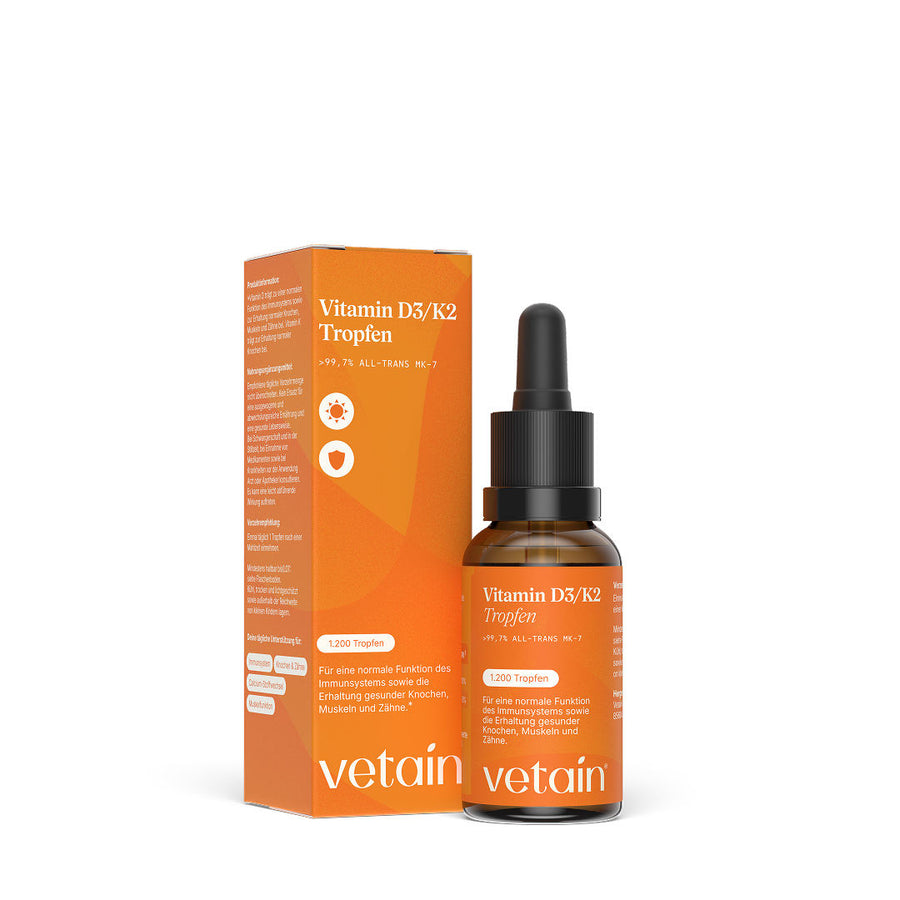
Drops like Vetains Vitamin D&K2 drops are currently very popular, Because they are easy to use, super flexible, and easy to take. Plus, they are often cheaper than tablets.
-
Our self-test It shows which products are best suited for you – try it out!
What vitamin D supplements are available?
Vitamin D comes in many different forms. The most common are vitamin D drops, tablets, and capsules.
-
Vitamin D drops They usually come in a small bottle with a pipette, which makes it easy to put the drops directly onto your tongue or a spoon.
-
Vitamin D tablets They are often packaged in a blister pack and are taken with a large glass of water at a fatty meal.
-
Vitamin D capsules They are often slightly larger than tablets, but their application is quite similar.
But which is better: vitamin D drops or tablets? We'll investigate.
Quick tip: In our article about Effects of Vitamin D Find out what vitamin D does in our bodies.
Comparison: Drops and tablets
The table shows the differences so you can see whether vitamin D drops or tablets are more suitable for you.

Here's a summary of the most important points:
-
Vitamin D drops are often dissolved in oil, which reduces the amount of vitamin D (which is fat-soluble) in the body better received This can be done. With capsules and tablets, this is usually not the case, which is why they should often be taken with a fatty meal.
-
Vitamin D drops can flexibly dosed are, while tablets and capsules specify a fixed dose.
-
Vitamin D in drop form is usually very simple in composition Tablets and capsules often contain additional excipients.
-
Vitamin D drops are very easy to take and neutral taste, which is practically useful for everyone who takes tablets & Some people have problems with them. Depending on the variety, they can be difficult to swallow and sometimes have an aftertaste.
-
Vitamin D tablets are precisely dosed and you get one with every tablet fixed dose. Precise dosing with drops can be difficult for some. Simple instructions (like Vetain's Vitamin D drops: 1 drop) help with the correct dosage.
-
Vitamin D drops are frequently per daily dose cheaper Available as capsules and tablets. Drops often last longer. Vetain's Vitamin D drops, for example, last for more than 3 years.
%-split_content-%
Which is better: vitamin D tablets or drops?
So which is better? Vitamin D drops or tablets? There's actually no single answer to that. Drops, tablets, and capsules can all contribute to your vitamin D intake and be part of your daily supplement routine. Both forms can be beneficial and each has its own advantages and disadvantages.
Which product is better for you depends entirely on what's important to you and which form of administration you prefer. Many find the simple and uncomplicated intake of drops convenient, while others prefer tablets, which are easy to take with them when traveling.
Are you unsure which shape suits you better?
Test: Vitamin D in drops or tablets?
-
intake
A: I have no problem with pills.
B: I don't really like the feeling of tablets or I have trouble swallowing them. -
dosage
A: A fixed dosage is sufficient for me.
B: I want to be able to adjust the dose flexibly (z.B. (e.g., with a higher dose prescribed by a doctor) -
Everyday
A: I consciously plan my supplements around meals and fixed routines.
B: I want to integrate my vitamin D into my everyday life in a straightforward way – even independently of meals. -
Travel
A: I travel a lot and therefore prefer supplements in solid form.
B: I travel a lot and appreciate being able to take the drops even when traveling without meals. & Co. can take. -
flexibility
A: I have set times and always take my supplements at the same time.
B: My daily routine isn't the same every day – I need something that adapts. -
compatibility
A: I can tolerate tablets. & Possible additives are usually good.
B: I sometimes have a sensitive reaction to tablets or additives. -
The taste
A: I don't care about the taste.
B: I am sensitive to taste and smell and prefer solutions that are as neutral as possible.
Evaluation:
If you have selected A more than 4 times, it will match. tablets Probably better for you.
If you have chosen B more than 4 times, it will match. drops Probably better for you.
So, what were the results of the test? Vitamin D drops or tablets? If you'd like to buy your vitamin D drops right now, you can do so here:
%-split_content-%
Incidentally, the composition and properties of the individual products are actually much more important than the form of administration.
Finding good vitamin D supplements
When considering whether vitamin D drops or tablets are better, it is essential to point out that, as with everything in life, there are excellent and less effective products in both drop and tablet form.So whether you choose vitamin D drops or tablets, there are a few things you should pay attention to when buying vitamin D.
-
purity: High-quality supplements have a clear and short list of ingredients. They are formulated with clean ingredients and avoid unnecessary additives.
Vetain's drops, for example, contain only 3 ingredients: vitamin D, a carrier oil and vitamin K (since they are vitamin D3 + K2 drops). -
Origin: Make sure that the supplement was manufactured in Germany or Europe under high safety standards.
-
dosage: The dosage should be clear, precise, and appropriate. Professional organizations such as the German Nutrition Society (DGE) recommend a daily intake of 20 µg for vitamin D. This applies to healthy adults who lack the body's own ability to synthesize it.
-
Certifications: Look for independent tests such as official certifications and lab tests. These will help you identify high-quality supplements.
-
High-quality carrier oils: Drops usually contain carrier oils. Suitable oils include MCT oil or olive oil.
By the way: There are also vegan vitamin D supplements – regardless of whether you prefer vitamin D drops or tablets.
Vitamin D with or without K2.
If you want to supplement with vitamin D, you not only have the choice between vitamin D drops or tablets, but also whether you want to take vitamin K as well. The good news: it's entirely your decision. Many people prefer taking both vitamins together and opt for vitamin D. & Some people are returning K2 drops or tablets, i.e., combination preparations. Others don't consider it so important.
So if your nutrient supply is important to you and you would like to supplement with vitamins without having to deal with it too much, vitamin D3 drops with K2, like those from Vetain, can be a practical combination for you.
Also of interest: What's the best way to take vitamin D? Our comprehensive guide!
Conclusion
Drops, capsules, or tablets? The choice is often difficult, and what suits you best depends on your needs. preferences and needs Let's find out which product is best for you. Take our self-test to discover which one suits you best. But always remember: ultimately, it's less important whether you take vitamin D drops or tablets, but rather how well-formulated your product is and whether you take it regularly and correctly. You'll learn more about this in our blog over the next few weeks.
Why the decision of whether to choose vitamin D drops or tablets is not as important in summer as in winter is explained in our article "Vitamin D in winter"If you need other supplements besides vitamin D, take a look at our..." Dietary supplement shop over.
Do you have any questions? Then feel free to write me a message. Mail - I look forward to hearing from you! :)
The information shared in this article does not replace individual medical or nutritional advice.
literature & Sources
-
BfR (Federal Institute for Risk Assessment) (2023). Vitamin D supplements – useful or unnecessary?
-
BfR (Federal Institute for Risk Assessment) (2014). Selected questions and answers about Vitamin D.
-
DGE (o.J. ). Vitamin D. https://www.dge.de/wissenschaft/referenzwerte/vitamin-d/
-
Franklin M.H. , et al. (2020). Are Vitamin D3 Tablets and Oil Drops Equally Effective in Raising S-25-Hydroxyvitamin D Concentrations? A Post-Hoc Analysis of an Observational Study on Immunodeficient Patients. In: Nutrients, 12(5)