


















 7 Min
7 Min
 Zuletzt aktualisiert am 23.09.2026

Where is omega-3 found - and why is this particularly complicated for vegans? Omega-3 fatty acids belong to the polyunsaturated fatty acids that your body cannot - or can only do so to a limited extent - produce itself. You therefore have to obtain them through your diet. The problem: The important omega-3 fatty acids EPA and DHA are found almost exclusively in fish. So what now? Vetain! Our article shows you where omega-3 is found, which foods are really worthwhile and what solution there is to the fish problem.
Your knowledge to go: Where is omega-3 found?
-
Top sources of omega-3 include oily sea fish such as salmon, mackerel and herring, as well as plant-based foods such as flaxseed oil, walnuts and chia seeds.
-
The problem for vegans: Plant-based sources contain almost exclusively ALA, not the forms DHA and EPA that our bodies can use directly. ALA first has to be converted into EPA and DHA so that it can be properly utilized by the body.
-
If you eat little fish, supplements could be an alternative - algae oil capsules are suitable for vegans.
Top 10 omega-3 sources
Where is omega-3 found ... in particularly high concentrations? Here are ten foods high in omega-3*:
-
Flaxseed oil - approx. 53 g per 100 g
-
Cod liver oil - approx. 29 g per 100 g
-
Flaxseeds - approx. 20 g per 100 g
-
Chia seeds - approx. 19 g per 100 g
-
Hemp oil - approx. 19 g per 100 g
-
Walnuts - approx. 10 g per 100 g
-
Rapeseed oil - approx. approx. 8 g per 100 g
-
Anchovy - approx. 3.1 g per 100 g
-
Trout - approx. 3 g per 100 g
-
Salmon - approx. 2.6 g per 100 g
You have probably noticed: Plant-based sources such as delicious nuts and seeds are right at the top - isn't that great? Unfortunately, not entirely. Plant-based foods contain an omega-3 fatty acid that cannot be directly utilized by the human body, but first has to be converted into other forms. More on this in a moment.
By the way: We have not actually included some good sources, because foods such as spiny dogfish or eel are unlikely to be on most of our menus regularly. We have also left out some oils and types of nuts from the list so that you can better see the variety - more on this below.
What omega-3 fatty acids are there, and what is the problem for vegans?
As already mentioned, not all omega-3 fatty acids are the same. There are three main types that you should know about:
-
Alpha-linolenic acid (ALA): The plant-based form found in flaxseeds, walnuts, chia seeds, rapeseed oil & other plant-based foods.
-
Eicosapentaenoic acid (EPA): An Omega 3 fatty acid found mainly in fatty marine fish and algae.
-
Docosahexaenoic acid (DHA): Another form found primarily in fish and microalgae.
The problem for vegans: In their daily diet, they mainly consume ALA - EPA and DHA are often available to vegans only sporadically through a portion of avocado sushi. Unfortunately, ALA is less usable by our bodies than EPA and DHA.
You can already see that it’s not just the question “Where is Omega 3 found?” that matters; the type of Omega-3 fatty acid also plays an important role. Why is that?
The problem with plant-based Omega-3 sources
This is where things get interesting - and unfortunately a little more complicated. Plant-based Omega 3 sources such as flaxseed oil or walnuts contain impressive amounts of Omega 3, but only in the form of ALA. However, your body uses primarily EPA and DHA for various functions.
The good news is: ALA can be converted into EPA and DHA in our bodies - without you even noticing.
But: The conversion rate from ALA to EPA is only around 5-10%, and the conversion rate to DHA is even below 1%. This means that even if you consume lots of nuts & seeds every day, only a fraction of them reaches your metabolism as usable EPA & DHA.
For vegetarians and vegans, this is a real challenge when it comes to getting enough Omega 3. But don’t worry: There are solutions - more on that later. First, though, let’s take a look at some animal-based Omega-3 sources, because not every one of our readers is probably vegan.
Incidentally, anyone who thinks that plant-based Omega 3 is less beneficial or that animal-based foods are better is not entirely right, because: Plant-based Omega 3 is actually the original form of Omega-3 fatty acids. Fish and other marine creatures, supposedly the “better” sources, contain the readily usable forms EPA and DHA primarily because they eat plant-based Omega-3 sources such as algae or microalgae.
Back to the topic - so: Where is Omega 3 found? We want numbers! If you’re in the mood for even more numbers, you might find our article on Omega-3 requirements interesting!
Where is omega-3 found - Animal-based foods
Where is omega-3 found if we look only at animal sources? Here is an overview of 20 common animal-based foods:
| Food | Omega-3* / 100 g raw food |
|---|---|
| Cod liver oil | 29 g |
| Anchovies | 3,1 g |
| Trout | 3 g |
| Salmon | 2,6 g |
| Herring | 2,4 g |
| Mackerel | 1,9 g |
| Sardines | 1,3 g |
| Tuna | 1,2 g |
| Shrimp | approx. 0.4 g |
| Butter | 0,3 g |
| Chicken egg | approx. 0.1 g |
| Whole milk | 0,02 g |
Important note:
When it comes to omega-3 content, the origin and processing both make a difference: Wild salmon, for example, often contains more omega-3 than farmed salmon because wild fish eat more algae and small marine animals rich in DHA and EPA. This also explains why you find different values in different articles. We primarily use the BLS values for raw foods.
In focus: Which fish contains the most omega-3?
When we ask ourselves, "Where is omega-3 found?", the answer is almost always "Fish!" The clear frontrunners among fish are the fatty cold-water fish:
| Fish | DHA + EPA / 100 g raw fish |
|---|---|
| Trout | 3 g |
| Salmon (wild) | 2,6 g |
| Herring | 2,4 g |
| Mackerel | 1,9 g |
| Sardine | 1,3 g |
| Tuna | 1,2 g |
When considering where omega-3 is found, preparation also plays a role: Some of the unsaturated fatty acids can oxidize when frying or grilling. They are therefore partially destroyed. Raw or gently cooked fish fillets therefore retain more omega-3.
Where is omega-3 found - Plant-based foods
Now let's turn to plant-based sources. Where is omega-3 found when it comes to seeds, nuts, and oils?
| Food | Omega-3* (ALA) / 100 g raw food |
|---|---|
| Flaxseed oil | 53 g |
| Flaxseeds | 20 g |
| Chia seeds | 19 g |
| Hemp oil | 19 g |
| Walnut oil | 12 g |
| Walnuts | 10 g |
| Rapeseed oil | 8 g |
| Soybean oil | 8 g |
| Plant-based, fortified margarine | 4 g |
| Nori sheet (roasted) | 0,79 g |
| Tofu | 0,48 g |
| Edamame | 0,38 g |
| Kale | 0,3 g |
| Pumpkin seeds | 0,22 g |
Important to know: Almost all of it is ALA - the form that your body first has to convert. Walnuts or flaxseeds can therefore be part of a healthy diet, but as sole sources of omega-3, they are often insufficient for providing EPA and DHA.
Extra tip: Nori seaweed actually contains EPA and DHA in their direct form!
In focus: Which oil contains the most omega-3?
Which oil contains the most omega-3 fatty acids? Here is a comparison:
| Oil | Omega-3* / 100 g |
|---|---|
| Flaxseed oil | 53 g |
| Fish liver oil | 29 g |
| Hemp oil | 19 g |
| Walnut oil | 12 g |
| Rapeseed oil | 8 g |
| Soybean oil | 8 g |
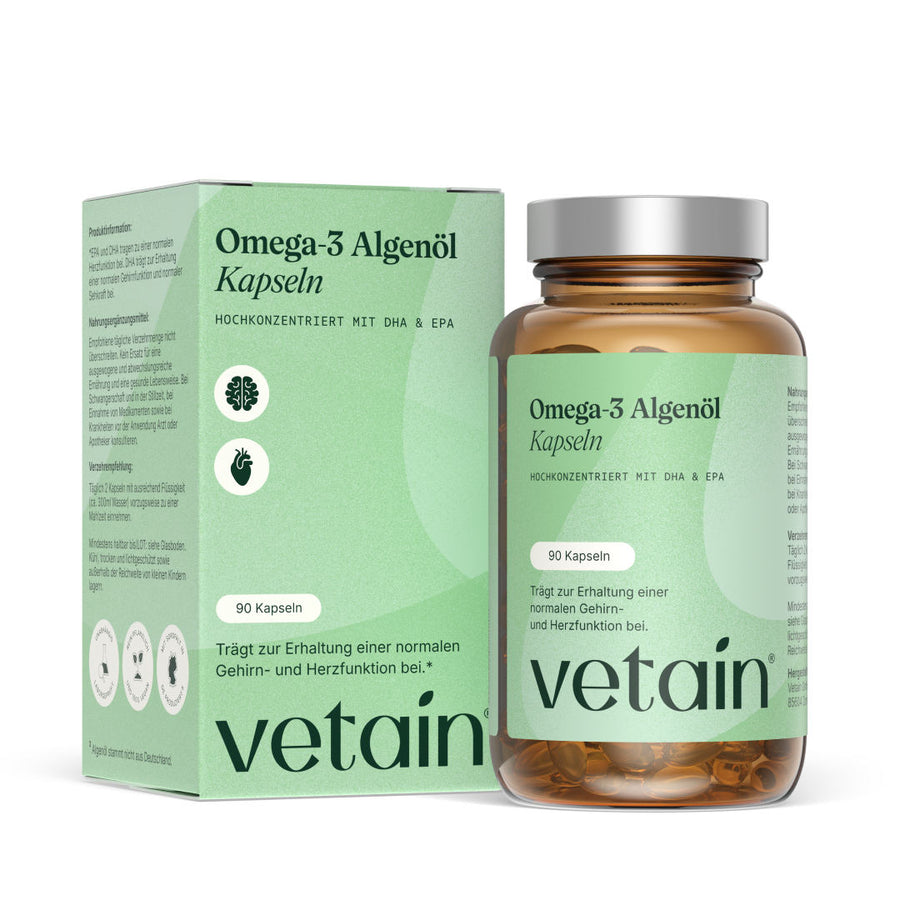
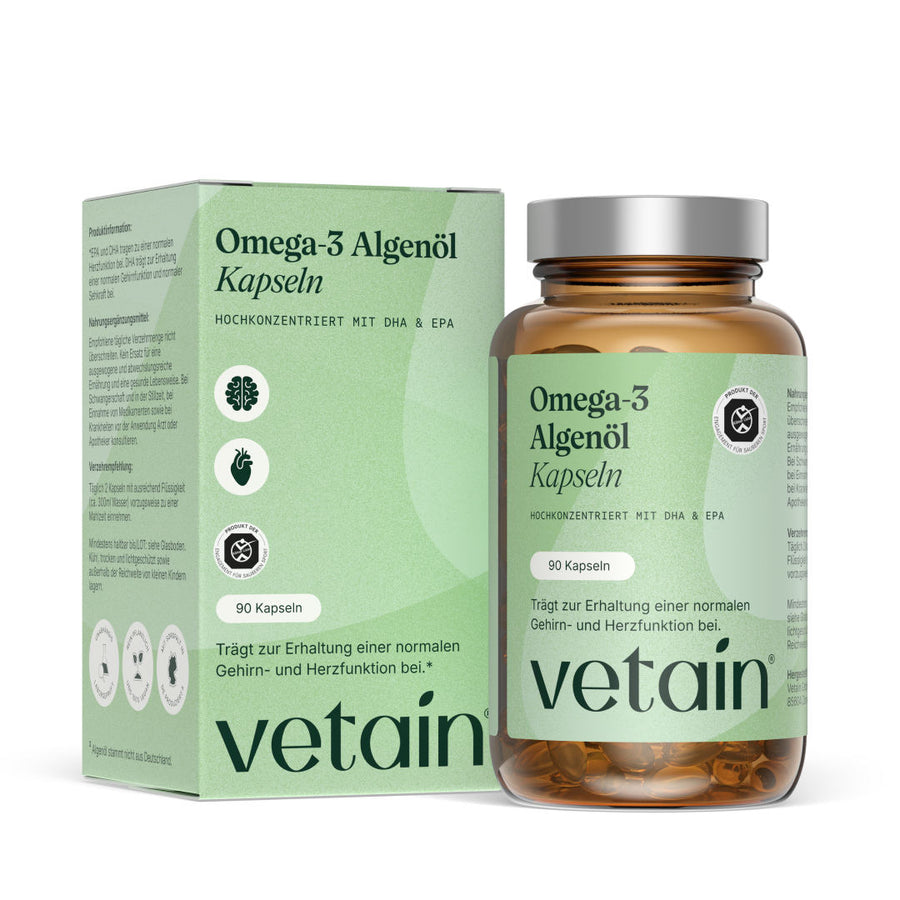
And of course, our omega-3 algae oil also has a high omega-3 content: The daily dose contains 450 mg of omega-3.
%-product_content-%
Caution: Omega-3 oils like these are often very sensitive! Always store them in a cool, dark place, preferably in the refrigerator. After opening, you should use them within 4-6 weeks. Many oils are not suitable for heating - it is better to use them for dressings, smoothies, or drizzle them over prepared dishes.
How to get enough omega-3
If you really eat fish regularly (1-2 times a week), you can skip this section. If not, things are about to get interesting for you. This section is about how to get enough EPA and DHA, even if you are vegetarian or vegan or eat little fish. The widespread and increasingly popular option: omega-3 supplements! They are also available in vegan form – as algae oil.
When can omega-3 supplements be useful?
-
If you follow a purely plant-based diet without fish
-
If you don't like fish
-
If your needs are increased
-
If your diet generally contains few omega-3 sources
Algae oil is therefore the plant-based solution to the vegan problem. It is sustainable, usually free from contaminants such as heavy metals and a genuine alternative to fish or fish oil.
Well, curious now? Then go ahead and get yours or take our test: Fish oil or algae oil – which suits you better?
%-split_content-%
With supplements, you never have to wonder again: Where is omega-3 found?
Conclusion
Where is omega-3 found? In many foods – but not always in the same form. Fatty fish such as salmon, mackerel and herring provide EPA and DHA directly. Plant-based sources such as flaxseed oil, walnuts and chia seeds are rich in ALA, which the body can only convert to a limited extent.
For vegetarians and vegans, this presents a particular challenge when it comes to obtaining the long-chain omega-3 fatty acids. The good news: Algae oil is a plant-based alternative that provides DHA and EPA directly.
Do you have any questions? Feel free to send me an email – I look forward to hearing from you! :)
The information shared in this article does not replace individual medical or nutritional advice.
Literature & Sources
-
Cholewski, M., Tomczykowa, M., & Tomczyk, M. (2018). A Comprehensive Review of Chemistry, Sources and Bioavailability of Omega-3 Fatty Acids. Nutrients, 10(11), 1662.
-
Lane, K. E., & Derbyshire, E. J. (2018). Omega-3 fatty acids – A review of existing and innovative delivery methods. Critical Reviews in Food Science and Nutrition, 58(1), 62-69.
-
Welch, A. A., Shakya-Shrestha, S., Lentjes, M. A., Maylin, S., & Sherwood, R. A. (2010). Dietary intake and status of n-3 polyunsaturated fatty acids in a population of fish-eating and non-fish-eating meat-eaters, vegetarians, and vegans. American Journal of Clinical Nutrition, 92(5), 1040-1051.
-
German Food Code (BLS), Version 3.02, Max Rubner Institute.
*The omega-3 values are always rounded, because nobody wants to deal with super complicated numbers, right?