

















 7 Min
7 Min
 Zuletzt aktualisiert am 23.09.2026

Creatine – Miracle cure or scam? Creatine is currently becoming increasingly popular. Especially active athletes swear by the effects of the supplement. But what's the truth behind it? What does creatine actually do?? And does creatine still do anything if you don't do any sports (I'm asking for a friend)?
We'll take a look at all of that together in the next few minutes!
Your knowledge on the go: What does creatine do?
-
Creatine is produced using amino acids and is a naturally occurring substance in the body that plays a particularly important role in the energy metabolism of muscles. Many people are familiar with creatine from sports.
-
Creatine can be thought of as an energy storage medium or energy supplier – so It can contribute to improved performance in speed-strength training.
-
Creatine supplements can help supply your muscles with an extra dose of creatine. and are associated with water retention (you know this as the infamous bulging muscles).
What is creatine and where is creatine found?
Let's briefly return to the Basics about creatine: Creatine is a naturally occurring substance in our bodies, formed from amino acids. Creatine plays a major role in many areas of our bodies. Therefore, it's practical to always have enough of it on hand. That's no problem! Creatine can be obtained either through... Nutrition (Meat, fish and milk) are ingested, or the body simply produces it itself.
Creatine can also be used as Supplement Take creatine. Taking creatine can be beneficial to replenish stores and provide the body with extra creatine.
You can find more information about how much creatine per day is beneficial and how to take creatine in our article "Creatine: Intake, dosage and other important information".
Now, let's get to the question: What does creatine do?
Overview: What does creatine do in the body?
Creatine is considered to be popular supplement in sports. But creatine is also very important in other ways, and current studies show that Impact on many areas investigated (so far without confirmed results):
-
Brain
-
nervous system
-
mental health
-
immune system
-
Muscles (clear)
Okay, we'll remember that creatine really has its fingers in every pie.
But let's be honest – we all want to know what creatine is all about in sports.
What does creatine do in sports?
So, what does creatine do to the muscles? Clear question, clear answer.
It is part of the Energy supply to the muscles and This increases physical performance during explosive strength training as part of short-term, intensive physical activity (at 3 g per day). Furthermore, it is being discussed whether creatine could also be related to regeneration or stress reactions – however, there is no conclusive evidence for this.
Let's take a closer look:
Creatine is stored in muscles (especially in type 2 muscle fibers) as creatine phosphate. Creatine phosphate is simply the compound of creatine with a phosphate group. This phosphate group is responsible for creatine's crucial role in muscle energy metabolism, enabling it to provide muscles with energy very quickly.
How does that work?
Muscles need ATP as an energy store.
Reminder: ATP = Adenosinetriphosphate
When ATP is consumed, it is converted to ADP (adenosine).di(phosphate), so it loses a phosphate group and can no longer provide the muscles with energy. And then what? Is that it? No! Because this is where our creatine comes in and saves the day – or the workout. Creatine, in its storage form creatine phosphate, simply releases its bound phosphate. This can then be combined with ADP, and we get new ATP and thus new energy! Hooray!
Creatine is also part of ATP production and therefore involved in the Energy supply to the muscles. This is particularly relevant for all sports that require type 2 muscle fibers (also known as fast-twitch fibers in fitness terminology). This is because creatine is primarily stored in these fibers.
This is the case, for example, in strength training with explosive movements. But creatine can also be beneficial in endurance sports if it has a positive effect on the regeneration has.
%-split_content-%
What creatine cannot do
Just because you take creatine won't suddenly make you stronger or your muscles three times as big – which is a shame. Instead, you can simply do more repetitions of an exercise, lift slightly heavier weights, or recover faster between sets. This allows your muscles to be stimulated even more intensely, which in turn promotes muscle growth. And voilà, gradually (if you take creatine regularly and train effectively), you'll get stronger.
That also answers my question… er… a friend’s question: Creatine without training won’t do much for your muscles. You have to exercise to see any effect.
Creatine isn't just important in sports! What else does creatine do?
What does creatine do to hair?
Oops, I think we've taken a wrong turn somewhere. Creatine has something to do with your Hair There's very little to do. keratin However, it does have a positive effect on your hair. And although the name might suggest otherwise, the two are unrelated.
What else is good for your hair? A healthy eating and a sufficient Supply of vitamins and minerals.
%-product_content-%
Let's try again: What else does creatine do?
What does creatine do for women?
Several studies have shown that Creatine for women It plays a special role and is very important. This also makes sense, because women have smaller creatine stores than men.Creatine supplementation therefore leads to a significant percentage increase in creatine in the body.
Women can in almost all phases of life Take creatine. However, it becomes particularly interesting after menopause: there are currently many studies on this topic.
What other effects does creatine have on the body?
What does creatine do in the rest of the body? We briefly saw earlier which areas creatine affects. Let's take a closer look!
An article by the International Society of Sports Nutrition has shown just how high the potential of creatine is: Research is investigating, for example, whether creatine is beneficial in... neurological Questions can be investigated – so far without reliable clinical recommendations.
This sounds like it would be really worthwhile to look into creatine supplements. But before we do that, we need to briefly look at the downside of creatine – don't worry, it sounds more dramatic than it is. I just wanted to build some suspense.
Side effects of creatine
What are the downsides of creatine? Like everything in life, creatine has its problems. Theoretically, taking creatine supplements can lead to side effects. However, these are very minor. rarely and usually at all not bad.
Possible side effects in rare, isolated cases and at very high doses (more than recommended):
-
Flatulence
-
mild diarrhea
-
Muscle cramps
If you follow the dosage recommendations and choose a high-quality creatine supplement, the chances are high that you won't experience any side effects. Creatine is considered a very safe supplement when used correctly.. Of course, this assumes that you are healthy and that your creatine is free of heavy metals and other impurities.
But what can happen is that you accidentally injure something. Weight You'll gain weight because creatine promotes water retention in the muscles. This is accompanied by the well-known "pump effect"—the muscles appear larger. While some find this annoying, others specifically aim for this effect. Whether this is a bad thing or a positive side effect is entirely up to you!
By the way: The plump muscles only last as long as you take creatine; after that, the effect disappears again.
Conclusion
The question “What does creatine do?” can be answered with one word: Many things!
Creatine isn't all the rage right now for nothing. What's really important is that you need to take creatine for several weeks to see any results. So don't give up after just two days because you haven't set a new personal record yet.
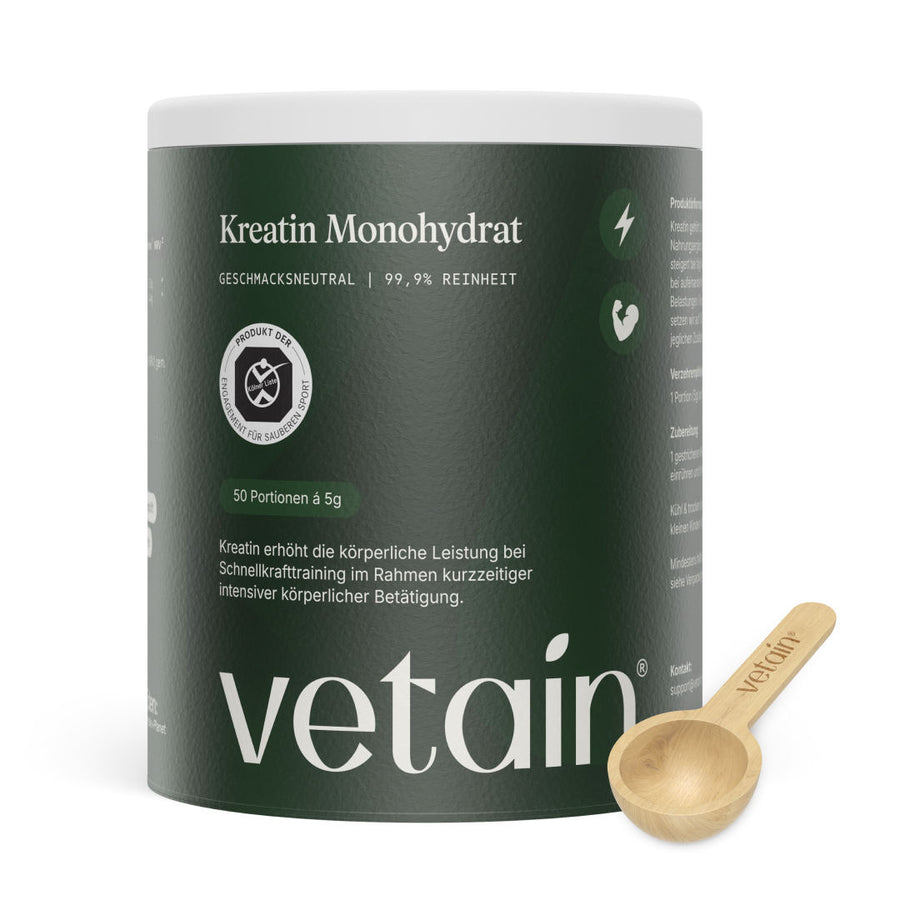
Creatine is one of the most well-known supplements of our time.Want to try it yourself? Sure! We have a Creatine Monohydrate available in our shop!
PS: Creatine, creatine and creatine are all the same!
literature & Sources
-
EFSA NDA Panel (EFSA Panel on Dietetic Products, Nutrition and Allergies) (2016). Scientific opinion on creatine in combination with resistance training and improvement in muscle strength: evaluation of a health claim pursuant to Article 13(5) of Regulation (EC) No 1924/2006. In: EFSA Journal, 14(2).
-
Kreider, RB et al. (2017). International Society of Sports Nutrition position stand: safety and efficacy of creatine supplementation in exercise, sport, and medicine. In: Journal of the International Society of Sports Nutrition, 14(1).
-
Smith-Ryan AE, Cabre HE, Eckerson JM & Candow, DG (2021). Creatine Supplementation in Women's Health: A Lifespan perspective. In: Nutrients, 13(3).
-
Swiss Sports Nutrition Society (2023). Supplement guide. A-Supplements: Performance Supplement. https://www.ssns.ch/wp-content/uploads/2023/12/SSNS-SG-Kreatin_V2.2.pdf
Do you have any questions? Then feel free to write me a message. Mail - I look forward to hearing from you! :)
The information shared in this article does not replace individual medical or nutritional advice.