




















 9 Min
9 Min
 Zuletzt aktualisiert am 23.09.2026

Creatine has now become part of the daily supplement routine for many physically active people. Nevertheless, many people do not know exactly how much creatine they should take. You often hear something about 3-5 grams - but is that right for everyone? How many grams of creatine per kg are actually needed, how many grams of creatine per day is already too much, and what the hell is a loading phase? We are now answering these exact questions thoroughly - including the latest research findings, so you do not have to rely on outdated rules of thumb from some forum.
Your knowledge to go: How much creatine per kg?
-
During the loading phase (optional): approx. 0.3 g of creatine per kg of body weight
-
During the maintenance phase: approx. 0.03 g of creatine per kg, usually 3-5 g per day in practice
-
The break: not necessary according to current studies
-
The appropriate daily creatine requirement depends on body weight - not on whether you are currently building muscle, losing weight, or maintaining your weight
-
Too much of a good thing? Above 3-5 g, more creatine provides no additional benefit, but may cause gastrointestinal discomfort in individual cases
Creatine effects
Before we get to the numbers, let's briefly cover the basics: What does creatine actually do, and why should you pay attention to the dosage? The best-established effect of creatine is in the area of athletic performance. In addition, research is currently examining what influence creatine could have on other areas of the body:
-
Brain
-
Nervous system
-
Mental health
-
Immune system
-
Muscles
The best-researched reason why most people take creatine in the first place is its effect in sports. Put simply: creatine increases physical performance during high-speed strength training as part of short-term, intense physical activity when at least 3 g are consumed daily. You can think of it this way: creatine serves your body as a kind of energy store, from which it can quickly replenish ATP during short, intense exertion. Creatine therefore gives your muscles more energy, enabling them to deliver more power for short periods.
Important: creatine is not a substitute for training. Without the stimulus provided by exercise, you will not automatically become stronger with creatine either - after all, it is not a miracle cure. You can find out exactly what creatine is chemically and where it occurs in the body in detail in our article "What is creatine?"
That makes it clear why creatine may be worthwhile. The real question remains: How much creatine per kg do you actually need?
How much creatine per kg - your overview
How much creatine per kg you personally need depends on the phase you are currently in. In sports science, two to three stages are distinguished here: the loading phase, the maintenance phase and - now controversial - the break. The good news upfront: As complicated as it sounds, the calculation is ultimately simple, because the dose is based on your body weight.
Loading phase: How much creatine per kg during the loading phase?
In early studies, researchers wanted to produce full creatine stores that could be detected as quickly as possible, so they had research participants take a significantly higher daily dose of creatine for several days. If you want this pace for yourself too, the amount of creatine per day looks like this:
-
Recommended dose: 0.3 g of creatine per kg, over 5-7 days, divided into several portions throughout the day. Depending on body weight, this amounts to 15-30 g per day.
Maintenance phase: How much creatine per kg during the maintenance phase?
Once your stores are full - whether with or without a loading phase - a significantly smaller amount is enough to keep them at this level permanently.
-
Recommended dose: 0.03 g of creatine per kg, or 1.5-3 g daily, depending on your weight.
-
In practice, however, most people do not follow their exact body weight that closely. Instead, they simply take the standard dose of 3-5 g of creatine per day - conveniently, this is also the amount at which the efficacy claim mentioned at the beginning applies.
And then there is the third, classic phase: the break. Originally, people took a break after several weeks of the maintenance phase - the idea was to give the body a kind of reset. In the meantime, however, this approach is outdated. For the sake of completeness: How much creatine per kg during the break? 0 g per kg! At least now you know that this is the simplest question of all. ;)
How much creatine per kg at a glance: loading phase, maintenance, break
| Phase | Usual duration | Dose | Really necessary? |
|---|---|---|---|
| Loading phase | 5-7 days | 0.3 g/kg (approx. 20-25 g/day) | No - optional |
| Maintenance phase | permanently | 0.03 g/kg or 3-5 g/day | Yes - that is the actual dose |
| Break | typically 2-4 weeks | 0 g | No - not necessary according to current research |
There is a well-established reason why the right column shows "No" twice for the loading phase and break: The International Society of Sports Nutrition (ISSN) concludes in its still-authoritative position paper that consistent intake without a loading phase ultimately works just as well. The only difference is speed: The classic study by Hultman et al. (1996, Journal of Applied Physiology) already showed that taking 3 g of creatine daily for 28 days fills muscle creatine stores just as effectively as a classic loading phase of 20 g daily for only 6 days - just more gradually. And as for taking a break: Continuous daily intake over months and even years is generally considered safe for healthy adults. If you still prefer to take breaks, there's nothing wrong with that - according to current knowledge, however, it isn't necessary.
%-split_content-%
Differences between men and women
So far, so general - but does this calculation for "How much creatine per kilogram?" actually apply equally to everyone? Many people assume that there are differences in creatine dosing between women and men. That is not generally the case: The same recommendation applies to both.
-
How much creatine per day for women: Loading phase 0.3 g/kg | Maintenance phase 0.03 g/kg
-
How much creatine per day for men: Loading phase 0.3 g/kg | Maintenance phase 0.03 g/kg
The fact that creatine dosages for men often look higher in absolute numbers is simply because men weigh more on average (not always!) than women and therefore reach higher total values. Per kilogram of body weight, however, the amount is exactly the same.
Age itself does not change the dosage: The creatine dosage for older adults, or the dosage during and after menopause, remains 0.03 g/kg during the maintenance phase or a flat 3-5 g daily.
Especially if you have pre-existing conditions or are in the middle of menopause, it's always worth consulting your doctor for an individual assessment of how much creatine per kg or per day is right for you. ;)
How much creatine per day calculator
Now that the theory is in place, let's get practical: How do you calculate your very own number? I know, most of us haven't had math class in a while, and sometimes even opening the calculator app feels like too much. If you want to calculate your creatine needs instead of looking them up in the table right away, here's your creatine calculator in three steps:
-
Take your body weight in kg - for example, 75 kg.
-
For the loading phase, multiply by 0.3 (75 × 0.3 = 22.5 g per day, divided into several servings).
-
For the maintenance phase, multiply by 0.03 (75 × 0.03 = 2.25 g per day) - most people practically round this up to 3-5 g, since that is the usual standard dose anyway.
By the way, if you have already come across a different figure: You sometimes also read the rule of thumb "creatine 1 g per 10 kg" of body weight (or creatine 0.1 g per kg) online as a supposedly simpler alternative. This is a rougher approximation and has been studied much less extensively. When in doubt, it is therefore better to rely on the scientifically better-supported recommendation of 0.03 g/kg or 3-5 g.
Anyone who wants to avoid doing the calculations altogether can find the approximate values directly in two tables:
How much creatine per kg during the loading phase?
| Weight | Creatine / kg | Total creatine |
|---|---|---|
| 50 kg | 0,3 g | 15 g |
| 55 kg | 0,3 g | 16,5 g |
| 60 kg | 0,3 g | 18 g |
| 65 kg | 0,3 g | 19,5 g |
| 70 kg | 0,3 g | 21 g |
| 75 kg | 0,3 g | 22,5 g |
| 80 kg | 0,3 g | 24 g |
| 85 kg | 0,3 g | 25,5 g |
| 90 kg | 0,3 g | 27 g |
| 95 kg | 0,3 g | 28,5 g |
| 100 kg | 0,3 g | 30 g |
How much creatine per kg during the maintenance phase?
| Weight | Creatine / kg | Total creatine (rounded) |
|---|---|---|
| 50 kg | 0,03 g | 1,5 g |
| 55 kg | 0,03 g | 1,7 g |
| 60 kg | 0,03 g | 1,8 g |
| 65 kg | 0,03 g | 2 g |
| 70 kg | 0,03 g | 2,1 g |
| 75 kg | 0,03 g | 2,3 g |
| 80 kg | 0,03 g | 2,4 g |
| 85 kg | 0,03 g | 2,6 g |
| 90 kg | 0,03 g | 2,7 g |
| 95 kg | 0,03 g | 2,9 g |
| 100 kg | 0,03 g | 3 g |
That should finally answer questions such as "How much creatine at 80 kg?" (24 g during the loading phase, 2.4 g during the maintenance phase), "How much creatine at 70 kg?" (21 g or 2.1 g), "How much creatine at 90 kg?" (27 g or 2.7 g), or "How much creatine at 100 kg?" (30 g or 3 g).
This leads to a completely different, but equally frequently asked question: What actually happens if you exceed this amount?
What happens if you take too much creatine?
In short: no extra miracles.
For a closer look, however, we first need to clarify how much creatine per kg is considered "too much". In general, doses of 3-5 g per day are considered safe - and thanks to the tables above, you already know exactly what that means for you per kg of body weight.
Taking more than this amount gives you no additional benefit: no better effect and no additional strength. Your body can only actually use a limited amount per day; the rest is simply excreted again. So this would primarily be a waste of money and product - money that you could instead save for a delicious protein bar:
%-product_content-%
Returning to the topic of creatine overload: A significantly excessive dose is not always completely without consequences. Possible effects may include:
-
Gastrointestinal complaints such as nausea or stomach pain
-
in individual cases, diarrhea or bloating
-
and, as mentioned, simply no additional performance benefit
The good news is that side effects are generally rare when creatine is taken at the recommended dosage.
How often should you take creatine?
How often should you take creatine, and how much creatine should you take if you cannot manage to take it at exactly the same time every day? You can divide the amount and dose of creatine per serving flexibly - the only important thing is the daily total. During the loading and maintenance phases, you should take creatine every day - not just on training days. Your muscles store creatine regardless of whether you are currently training, and they need to remain fully supplied at all times. If you stop taking creatine completely, your stores will return to their baseline level within about 4 weeks.
Tips for taking it:
-
Creatine is available as powder or capsules - the best known and most extensively studied form is creatine monohydrate in powder form - the creatine monohydrate dosage is also the basis for all recommendations mentioned here.
-
Simply stir the powder into water, a protein shake, your porridge, or a smoothie - unflavored creatine monohydrate is practically unnoticeable.
-
And: Creatine - how much water do you need with it? Drink enough, because creatine can draw water into your muscle cells, which increases your fluid requirements. You may even notice this on the scale. This is also why people often ask: How many kilos do you gain from creatine? For many people, 1-2 kg of additional weight is normal. This is almost entirely due to the stored water.
If you are also interested in what time of day makes the most sense for taking it, you can find all the details in our article "When should you take creatine?"
Does creatine actually contain calories?
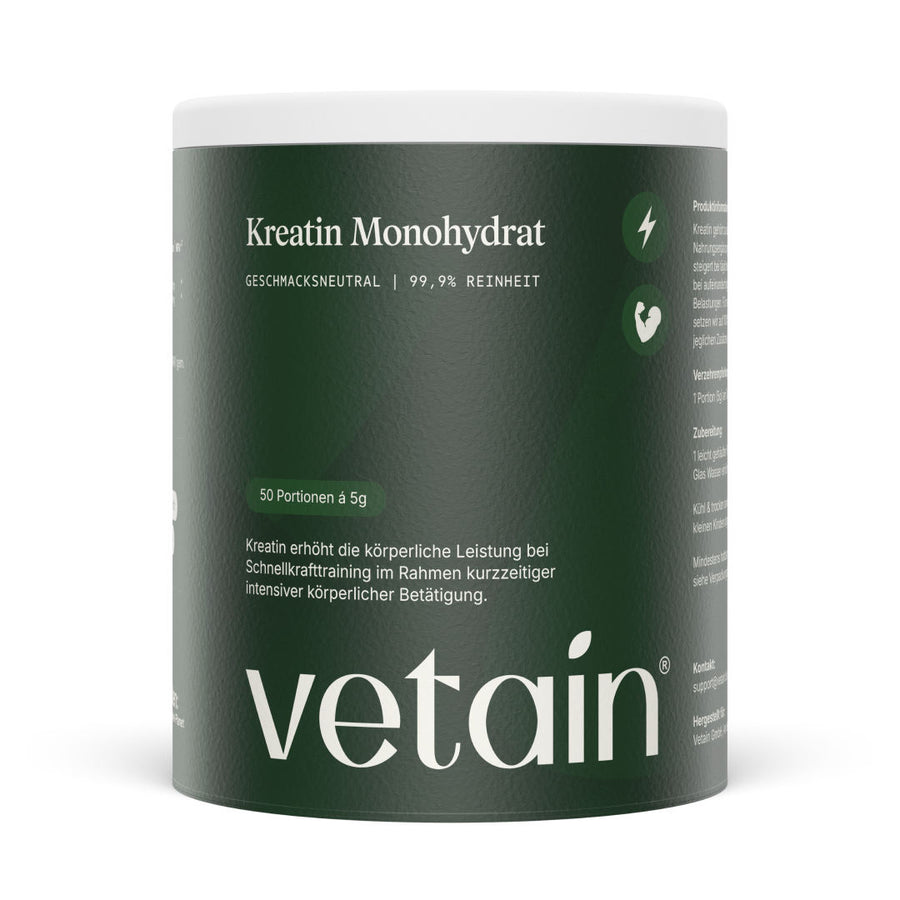
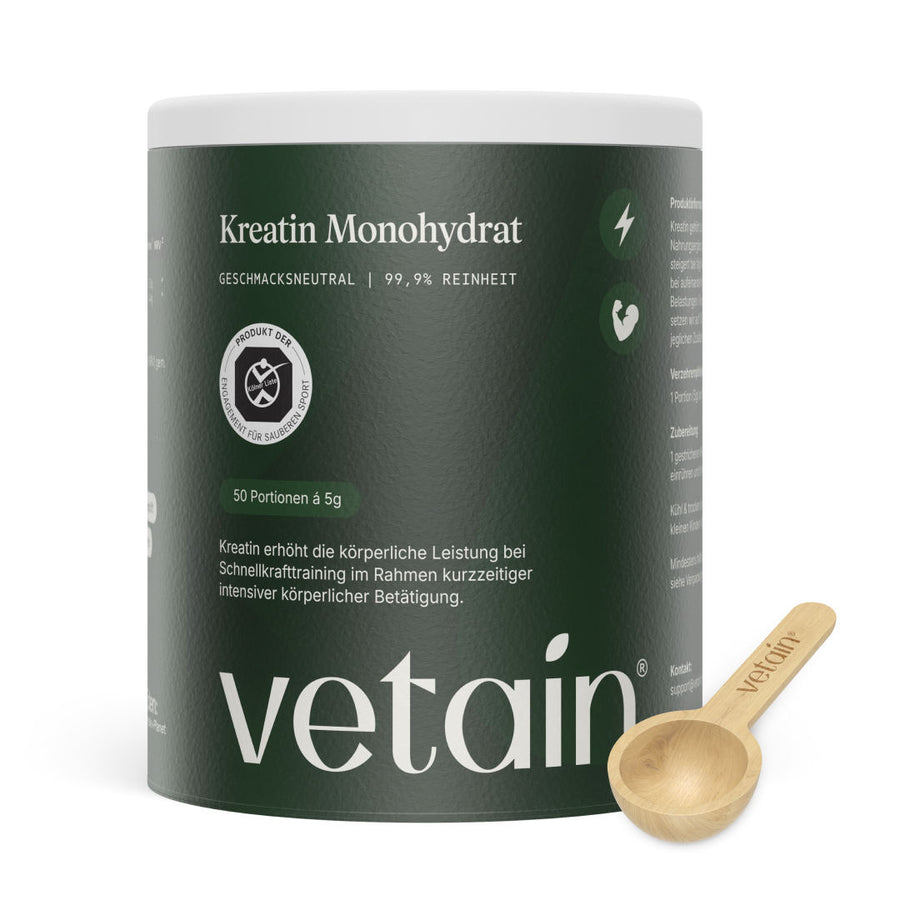
Interesting question: Does creatine actually affect your calorie balance? Short answer: no. Pure creatine monohydrate is not a macronutrient like fat, protein, or carbohydrates, but a nitrogen-containing organic acid that your body mostly produces itself or obtains through food. That is why the nutrition table for pure creatine monohydrate - such as Vetain Creatine Monohydrate - lists 0 kcal per serving.
If you're already keeping an eye on your daily requirements, feel free to also check out the Vetain Calorie Calculator.
How much creatine per kg?: A conclusion
This brings us full circle to the questions we asked at the beginning: you now know exactly how much creatine per day per kg is needed for every phase and body weight. The loading phase? Optional; it only speeds up the result. The break? According to the current state of scientific knowledge, it is not necessary. And fortunately, with creatine, it's difficult to take "too much" as long as you roughly stick to 0.03 g/kg during maintenance. So nothing stands in the way of your creatine journey.
If you want to delve even deeper into the topic, here are a few more articles from us – so you'll soon be a true creatine expert too:
-
Creatine intake, dosage, and everything else you need to know
-
What does creatine do? An overview of the research and its use in sport
-
Everything about the effects of creatine: how, why, and when to take it
PS: Always keep in mind that the internet contains a lot of outdated or simply incorrect information about how much creatine per kg is actually needed. So don't believe everything right away, and pay attention to trustworthy, up-to-date sources – like the ones we've compiled for you here.
Do you have questions about "How much creatine per kg?"? Feel free to send me an email – I look forward to hearing from you! :)
Literature & Sources
-
Kreider, R. B. et al. (2017). International Society of Sports Nutrition position stand: safety and efficacy of creatine supplementation in exercise, sport, and medicine. In: Journal of the International Society of Sports Nutrition, 14(1).
-
Hultman, E., Söderlund, K., Timmons, J. A., Cederblad, G., Greenhaff, P. L. (1996). Muscle creatine loading in men. In: Journal of Applied Physiology, 81(1).
-
Naddafha, S., Antonio, J., Kreider, R. B., Stout, J. R. (2026). Creatine monohydrate for lean mass, strength, and bone density in postmenopausal women: a systematic review and meta-analysis. In: Journal of the International Society of Sports Nutrition, 23(1).
-
Impact of creatine supplementation on menopausal women's body composition, cognition, estrogen, strength, and sleep (2025). In: Journal of the International Society of Sports Nutrition.
-
Nebel, R. (2002). Creatine in Sport – Ergogenic Supplement? In: German Journal of Sports Medicine, 53(7+8).
-
Swiss Sports Nutrition Society (2023). Supplement Guide. A-Supplements: Performance Supplement.