






















 6 Min
6 Min
 Zuletzt aktualisiert am 25.09.2026

Did you know that typical nighttime calf cramps often have nothing to do with a magnesium deficiency? But where magnesium really plays a role is in sports. For example, magnesium can influence your energy metabolism! So it’s no wonder that many physically active people swear by magnesium. But one question remains: Should Magnesium be taken before or after exercise? What makes the most sense?
Your knowledge to go: Magnesium before or after exercise?
-
Regular magnesium intake is part of many athletes’ sports routine .
-
The magnesium requirement can be met through diet and, if needed, through Supplements be covered.
-
Whether Magnesium whether it should be taken before or after exercise depends on your personal goals and preferences.
Why magnesium in sports at all?
Let’s start with the elephant in the room: Why should you take magnesium at all - quite apart from the question “magnesium before or after exercise?”.
Magnesium (like all other nutrients) is very important for us and is involved in many processes in the body, such as muscle contraction and bone metabolism. For example, magnesium contributes to the maintenance of normal bones and teeth and also to normal muscle function. And that brings us to the topic of sports!
An inadequate magnesium intake or even a magnesium deficiency can therefore affect you and your training. Depending on how severe the deficiency is, the effects may be only mild. However, additional symptoms may also occur.
What exactly are the benefits of magnesium for sports?
-
An adequate magnesium intake can help increase your muscle function to a normal level. So having an adequate supply of magnesium is really practical! ;)
-
Some studies have investigated a possible connection between magnesium status and muscle strength in the legs (But that doesn’t mean we can skip leg day - sorry).
-
An adequate magnesium supply contributes to normal energy metabolism with good ATP availability. Let’s remember: We need ATP as an energy carrier so we can have plenty of power.
Who needs magnesium?
So who is this relevant for? Do we all need to take magnesium now? No, don't worry! Basically, many people already get enough magnesium. Especially if you eat a balanced diet, you lay a good foundation for that.
There are three scenarios in which taking supplements may make sense:
-
Insufficient magnesium intake: Especially in sports where weight is monitored or in cases of an unbalanced diet, it may happen that not enough magnesium is obtained through the diet. Additional supplements are also often needed here!
-
Increased magnesium requirements: For people who are physically active, metabolism is often very active, which increases the need for magnesium and other nutrients.
-
Increased magnesium loss: Do you lose magnesium through sweat during training, or is that a myth? Well, studies are currently investigating how significant magnesium loss through sweat or urine really is.
Do you identify with one of these groups? Then it is particularly important now to pay attention to your magnesium intake and take supplements if necessary. How does that work? You will find out now!
Taking magnesium (diet & supplements)
How much magnesium is needed daily? Healthy women without increased requirements need around 300 mg of magnesium per day, while men need 350 mg. That may not sound like much, and it isn't. This amount can usually be consumed without any problems through a balanced diet. With 100 g of rolled oats, 30 g of pumpkin seeds, 100 g of spinach (cooked), and a banana, you are already very well supplied!
However, if you cannot manage this through your diet, supplements can be helpful.
Most importantly, first check whether you can improve anything about your diet: Do you eat plenty of seeds and kernels, whole-grain products, or legumes? No? Then perhaps green leafy vegetables, fish and seafood, or fortified mineral water?
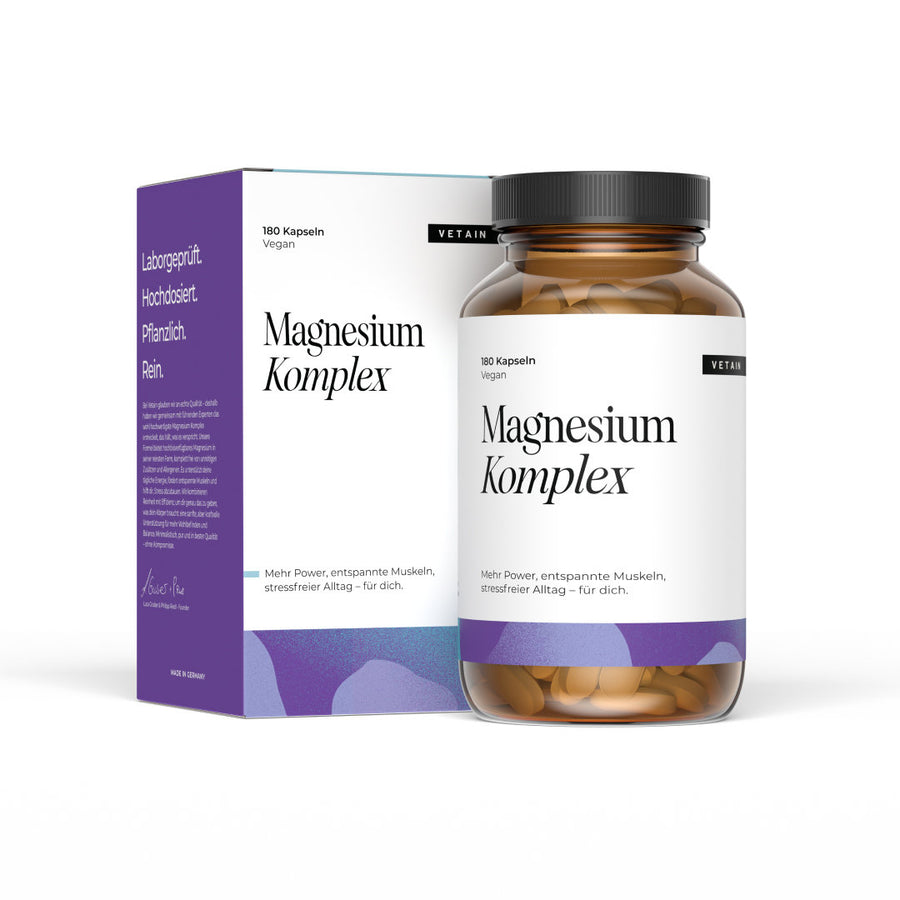
If your answer is no, you can start here. Otherwise, your magnesium supplement is already waiting here:
%-split_content-%
Our tip: Choose high-quality products and follow the daily recommended intake. Especially if you are sensitive to magnesium supplements, it may help to use slow-release products or spread your magnesium intake throughout the day.
Oops, we have lost the thread a little: Back to the topic! In case you have forgotten by now: It is about the question: “Magnesium before or after exercise?”. So how should you take magnesium?
Magnesium before or after exercise? The facts
So should you take magnesium before or after exercise? It is not that simple.
The most important thing is to ensure you have an adequate supply of magnesium overall and are not deficient. So the distinction between magnesium before or after exercise makes no difference!
When it comes to that little extra during exercise, we can say: Magnesium before exercise helps support your energy metabolism during training or competition. Magnesium after exercise can be part of your recovery routine. Whether you therefore prefer to take magnesium before or after exercise is entirely up to you. Both options can benefit you and are suitable for different goals.
So how about a combination of both?
Magnesium before exercise
-
Full magnesium stores are a good prerequisite for starting an effective workout. Magnesium before exercise supports your energy metabolism.
-
It supports normal muscle function during training.
-
When you lose sweat during training, your total mineral intake should be taken into account.
Caution: Sensitive people may experience gastrointestinal discomfort after taking magnesium - in that case, taking it directly before training would naturally be less beneficial. For some, a small snack made from natural sources of magnesium may be more pleasant in this situation.
Magnesium after exercise
-
Magnesium can be part of your after-sport routine after exercise. Always bear in mind (regardless of magnesium): Recovery is just as important as the training itself.
-
It can offset a possible magnesium loss during training.
-
There are studies investigating a possible connection between magnesium and muscle soreness - we will keep you up to date.
Most importantly: Simply taking magnesium on a whim is not necessarily sensible. Studies show that additional supplementation provides no further benefits when you already have an adequate supply. So it is also possible to take too much magnesium!
Conclusion: Magnesium before or after exercise?
When should you take magnesium when exercising? Both have advantages and can support you well in certain situations. However, neither option is clearly better or worse than the other. So simply try out what works best for you.
Many people who are active in sports rely on other supplements in addition to magnesium: Supplements for muscle building
%-product_content-%
Literature & sources
-
Bechtold, K. (2024). Advice on magnesium. In: DAS PTA MAGAZIN, 18(7).
-
DGE (2022). Selected questions and answers about magnesium.
-
DGE (n.d.) Reference values. Magnesium.
-
Kisters, L., Gröber, U. & Kisters, K. (2024). Magnesium in competitive sports. In: Journal of Orthomolecular Medicine, 22(03).
-
Saur, P. (2004). Magnesium and sports. In: German Journal of Sports Medicine, 55(1).
-
Vormann, J. (2015). Magnesium in sports - an underestimated mineral? In: Zaenmagazin, 7(3).
Do you have any questions or comments? Then feel free to write me an Email - I look forward to hearing from you! :)
The information shared in this article is not a substitute for individual medical or nutritional advice.