















 8 Min
8 Min
 Zuletzt aktualisiert am 28.09.2026

Protein is currently on everyone's lips and experiencing a real hype - protein-rich foods and protein powders are more popular than ever.
While some people can hardly get enough protein and follow one protein shake with the next, others shake their heads at exactly these people. Opinions on the topic of “How much protein per day?” vary widely, and often you no longer know what to believe yourself. Fortunately, science provides us with reliable, evidence-based information on this topic. And (fortunately again), there's us, Vetain. We give you answers to the most important questions in a simple, understandable, and engaging way.
Small spoiler: It's not as simple as you might think. Protein requirements are highly individual and are not a fixed quantity.
Your knowledge to go: How much protein per day?
-
Protein requirements are individual and depend on many different factors, such as body weight and activity level.
-
The recommendation for the general population is 0.8 g of protein per kg of body weight, which is about 48 g for a person weighing 60 kg.
-
However, different values apply to other groups, such as athletes, pregnant and breastfeeding women, and older adults.
-
Protein can be obtained from foods such as legumes, but products like protein shakes can also be a practical supplement.
%-product_content-%
How much protein per day: Your overview
When you search for how much protein per day is advisable, you often don't get a clear answer, but only information about how much protein is needed per kg of body weight. Great - do you now have to do the math to find out how much protein you need per day?! Why is this so complicated?
Well, protein requirements depend on many different factors:
-
Age
-
Body weight
-
Activity level
-
Goals
-
…
This shows why the answer to the questions “How much protein per day for men?” or “How much protein per day for muscle building?” cannot be a simple number. Instead, there are recommendations for different groups (such as physically active people, older adults, etc.) specifying how much protein is needed per kg of body weight. You can then use this to calculate your daily protein requirement yourself. This is intended to take as many influencing factors as possible into account and determine the required amount of protein as accurately as possible. Sometimes, however, you don't want to do advanced math, but simply get a clear answer. And that's exactly what we're here for!
Ready? Great! Now let's look at different population groups and find out how many grams of protein are needed per day. Don't worry, you can put away the calculator. You don't have to do anything - I'll take care of it for you. Let's get started!
General population
The general population includes all healthy 19–64-year-olds who do not engage in an unusually high amount of exercise. The recommended guideline for daily protein intake is 0.8 grams of protein per kilogram of body weight. How much protein is needed at 80 kg? That's right, 64 g!
Let's look at this for different weight classes:
-
40 kg → 32 g
-
50 kg → 40 g
-
60 kg → 48 g
-
70 kg → 56 g
-
80 kg → 64 g
-
90 kg → 72 g
-
100 kg → 80 g
I know, the likelihood that you weigh EXACTLY 60 or 70 kg and can read your requirement directly here is very low. But creating a list with every possible weight would be absolutely crazy. That's why this overview gives you an initial estimate of your ideal protein intake.
Physically active people
Anyone who does more than 5 hours of exercise per week has an increased protein requirement. Exactly how high is it? That's difficult to say! Especially among physically active people, there are many different views on how much protein is needed per day for strength training or bodybuilding.
Here, we follow the guidelines of renowned professional organizations:
Current recommendations for physically active people are 1.2–2 g of protein per kg. This range is explained by the fact that the exact requirement varies individually depending on factors such as training intensity and condition, as well as goals. Different values apply to high-performance athletes.
Let's take a look: How much protein per day for muscle building?
-
40 kg → 48–80 g
-
50 kg → 60–100 g
-
60 kg → 72–120 g
-
70 kg → 84–140 g
-
80 kg → 96–160 g
-
90 kg → 108–180 g
-
100 kg → 120–200 g
Now I understand why so many people at the gym drink one protein shake after another. With a daily requirement of 100 grams of protein or even more than 120 g of protein, shakes can really be a practical addition to your diet.
Older people aged 65 and over
From age 65, the protein requirement increases! The current estimate is approximately 1 g/kg. However, this is only a rough estimate: Since the group of people over 65 differs greatly in terms of illness, activity, and more, it is difficult to determine a value that is suitable for everyone. But let's take a look at the average amount of protein recommended per day.
-
40 kg → 40 g
-
50 kg → 50 g
-
60 kg → 60 g
-
70 kg → 70 g
-
80 kg → 80 g
-
90 kg → 90 g
-
100 kg → 100 g
So feel free to invite your parents and grandparents for a protein bar!
Women
Yes, women are part of the general population - no question about it! However, pregnancy and breastfeeding place special demands on the body, so the amount of protein needed also changes. Accordingly, the question "How much protein per day for women?" cannot be answered so simply. We need to look closely at the different groups.
How much protein per day for women during pregnancy?
There are fairly precise findings on how many grams of protein are needed per day during pregnancy. While the protein requirement remains at 0.8 g per kg of body weight during the 1st trimester, the requirement increases to 0.9 g/kg in the 2nd trimester and even to 1 g/kg of body weight in the 3rd trimester.
So we divide our overview as follows: 1st trimester | 2nd trimester | 3rd trimester
-
40 kg → 32 g | 36 g | 40 g
-
50 kg → 40 g | 45 g | 50 g
-
60 kg → 48 g | 54 g | 60 g
-
70 kg → 56 g | 63 g | 70 g
-
80 kg → 64 g | 72 g | 80 g
-
90 kg → 72 g | 81 g | 90 g
-
100 kg → 80 g | 90 g | 100 g
So the amount of protein increases by a total of 25 % on!
And how many grams of protein per day during breastfeeding?
During breastfeeding, the protein requirement is 1.2 g per kg of body weight - referring to the mother's weight, of course!
-
40 kg → 48 g
-
50 kg → 60 g
-
60 kg → 72 g
-
70 kg → 84 g
-
80 kg → 96 g
-
90 kg → 108 g
-
100 kg → 120 g
People who are overweight
People who are overweight also have some special considerations! Here, the daily protein requirement is also 0.8 g per kg of body weight. However, it is based not on current weight, but on ideal weight according to BMI! You can find this value by using a BMI calculator in reverse, so to speak. Since this is quite complex and depends, among other things, on age and height, we unfortunately cannot provide a comprehensive overview here.
By the way: If you’re wondering how much protein per day is recommended for weight loss, I have bad news for you: That can’t be said so simply either. Some people increase their protein intake when losing weight, while others do well with the normal protein intake of 0.8 g per kg. Ultimately, however, what matters most is lowering your calorie intake. But that is also a very undifferentiated statement and is not the subject here.
So, done. Now we can roughly estimate how much protein is needed per day. The problem: 60 g of protein doesn’t tell me much! So what does that amount look like in food?
How can I meet my protein requirement?
Here is an example of how you can easily meet a protein requirement of 60 g:
-
Breakfast: Baked oats with approximately 20 g of protein
-
Lunch: Indian dal with approximately 15 g of protein (legumes such as lentils are excellent plant-based sources of protein)
-
Coffee: Protein tiramisu with approximately 20 g of protein
-
Dinner: Protein wrap + spread of your choice with 10 g of protein
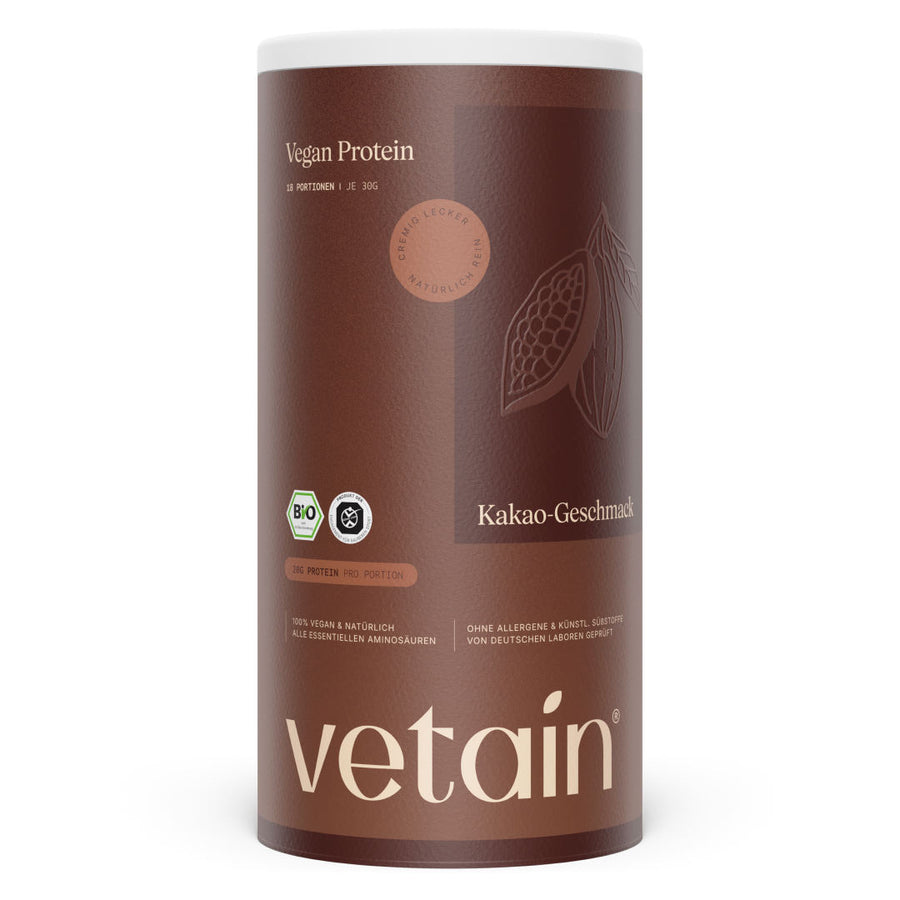
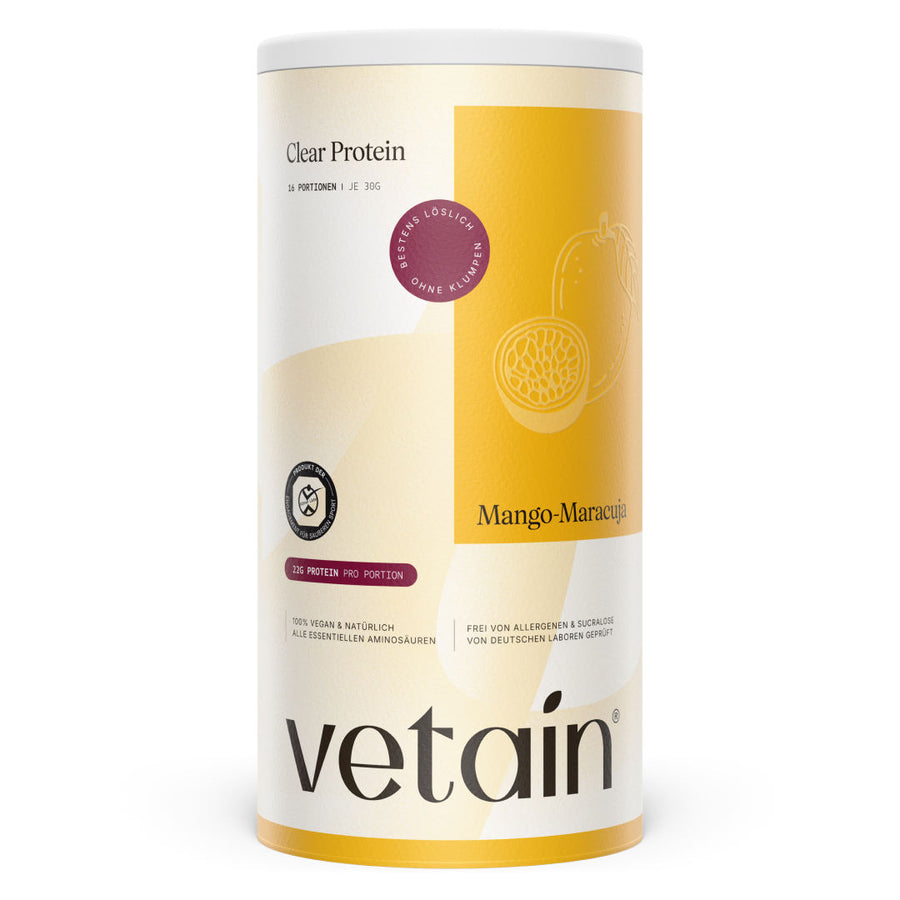
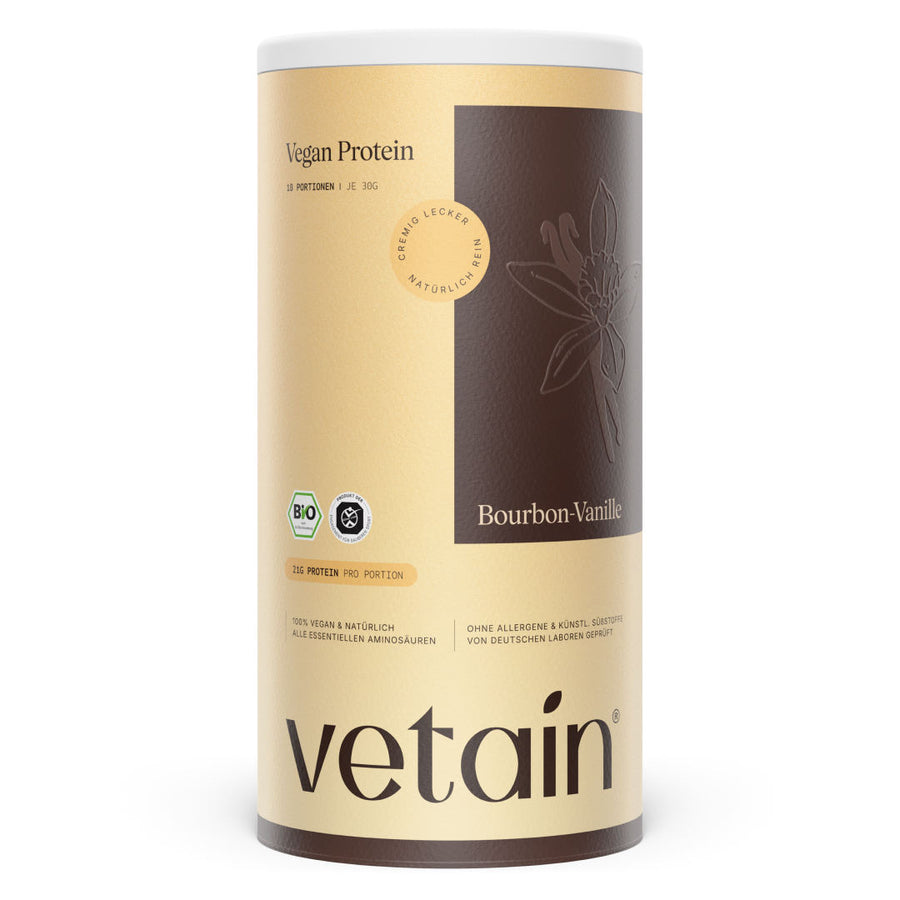
There we go! We’ve already covered the requirement. Always included: Vetain’s vegan protein powder!
%-split_content-%
And how do I get 80 g of protein per day? It’s easy: Leave out the protein tiramisu and replace dinner with a protein bowl containing 45 g of protein! That already brings you to 80 g of protein.
Very important: Make sure you consume enough calories!
More tips:
-
Other sources of protein include plant-based foods such as soybeans, quinoa, and peas.
Tip: You can find a list of other protein-rich foods in our article “What is high in protein?”. -
Naturally, it is not only the quantity but also the quality of the proteins that matters: Pay attention to a high biological value and as complete an amino acid profile as possible. Combining different plant-based protein sources, such as legumes with grains, ensures a balanced composition and a complete amino acid profile. Such a combination can increase the protein's bioavailability.
-
It is recommended to distribute protein intake across several meals throughout the day.
In conclusion
We now have a good overview of how much protein is needed per day and how we can consume enough protein. If you would like to know more, you can either get out your calculator again and calculate your very own personal protein requirement or read more about protein myths (also on the topic "How much protein per day"). Would you like to know whether there can also be "too much" protein intake? Then feel free to read more here.
Pssst, a little tip: If you don't want to calculate it yourself, I can recommend our calorie or protein calculator - it quickly gives you an indication of how much protein per day might be right for you!
Literature & sources
-
German Nutrition Society (DGE) (2021). Selected questions and answers about protein and essential amino acids.
-
German Nutrition Society (DGE) (n.d.). Protein. https://www.dge.de/wissenschaft/referenzwerte/protein/
-
König, D. et al. (2020). Position of the working group sports nutrition of the German Nutrition Society (DGE): protein intake in sports. In: German Journal Of Sports Medicine, 71(7-8–9).
-
Nutrition Hub (2024). Protein intake - Do we need more?
Do you have any questions? Feel free to send me an email - I look forward to hearing from you! :)
The information shared in this article does not replace individual medical or nutritional advice.